
AI Relationship management is the use of AI to automate the tedious or administrative parts of networking & relationships. That includes things like data entry, reminders, tracking follow ups, researching what people are up to and so on. Relationships however require humans to build them so the actual conversations & interactions are with you. AI is just the assistant that makes this all easier.
Definition
AI relationship management is the use of artificial intelligence — machine learning, natural language processing, and automation — to manage relationships and interactions at scale. It combines traditional CRM concepts with intelligent processing, so large volumes of relationship data turn into useful, surfaced insight instead of a database nobody updates.
Core Concept
Data-driven relationship management that actually uses the data you already have
Intelligent insights pulled from interactions, emails, social signals, and notes
Continuous learning from behaviour — the system gets better the more you use it
How AI Is Used in Relationship Management
The truth is, most of networking is admin. AI handles the admin so the human parts — judgment, warmth, timing — can be yours.
Data Analysis
Analyses contact behaviour and interaction history across channels
Identifies patterns and trends you’d never spot manually — who’s gone quiet, who’s warming up, who keeps referring you business
Automation
Automates repetitive tasks like logging meetings, transcribing voice notes, and extracting follow-ups
Reduces manual data entry to roughly zero, which is where it should be
Personalisation
Tailors communication suggestions based on each person’s context, interests, and history with you
Suggests relevant next actions — a congratulatory note, a check-in, an article they’d find useful
Predictive Insights
Forecasts which relationships are likely to go cold without attention
Surfaces relationship opportunities based on signals like job changes, funding announcements, or new posts
AI enables predictive analytics, automation, and personalised interactions — without replacing the human at the centre of the conversation.
Key Features of AI Relationship Management
A modern AI relationship management system combines a few capabilities that, together, change how networking feels.
Smart Contact Insights
Auto-enriched contact data pulled from public sources — no more half-filled fields
Behaviour-based insights: who’s active, who’s changed roles, who’s posting lately
Interaction Intelligence
Summarised conversations so you walk into every meeting with a two-line brief
Context-aware timelines across email, messages, LinkedIn, and voice notes
Automated Follow-Ups
Smart reminders timed around real signals, not arbitrary calendar intervals
Suggested next actions so you’re never staring at a blank message box
Sentiment Analysis
Reads the tone of conversations to flag engagement levels
Detects when a relationship is cooling off — often before you’d notice
Data Management
Handles structured and unstructured data: notes, emails, cards, messages, calls
Cleans and organises information so your network stays tidy without manual grooming
AI uses NLP and machine learning to interpret complex, messy data — so you don’t have to.
Benefits of AI Relationship Management
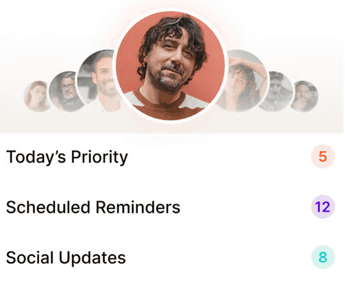
Here are some of the key benefits of AI relationship management: it helps you make better decisions about who to reach out to, when, and why. It also reduces manual work, improves personalization, and helps valuable relationships grow consistently over time.
Better Decision Making
When the system tells you who’s most worth a message this week — and why — you stop guessing. You make cleaner, faster calls on where your time goes.
Increased Efficiency
Reduced manual work means the difference between “I’ll update the CRM later” and actually having an up-to-date network. Workflows that used to take an hour a week collapse into ten minutes.
Improved Personalisation
Because the system remembers what someone mentioned six months ago, your outreach lands as “you remembered” rather than “generic touch.” That’s the whole game.
Relationship Growth
High-value connections get surfaced instead of buried. Long-term relationships strengthen because nothing falls through. You reach out to the right people at the right time — quietly, consistently.
AI improves personalisation, automation, and reporting — the three things that keep a network alive.
AI Relationship Management Use Cases
AI relationship management shows up wherever relationships drive outcomes.
Networking
Track and prioritise connections across conferences, introductions, and everyday conversations
Get a weekly shortlist of who to reach out to, instead of staring at 3,000 LinkedIn contacts
Sales and Leads
Lead scoring based on real interaction data, not guesswork
Opportunity tracking that surfaces warm leads before they turn cold
Customer Engagement
Personalised communication informed by each customer’s history
Real-time interaction insights so support and relationship teams stay ahead
Data Management
Automated data entry — scan, speak, or import, and the AI takes care of the rest
Data enrichment from public sources, keeping profiles fresh without manual effort
AI Relationship Management vs Traditional CRM
Traditional CRMs are databases. AI relationship management systems are assistants. Here’s how they differ in practice.
Data Handling
AI: Automated and intelligent — data enters and organises itself
Traditional: Manual entry — which is exactly why most fields stay blank
Insights
AI: Predictive and real-time — tells you what’s likely to happen, not just what already did
Traditional: Historical — reports on the past
Efficiency
AI: Automated workflows that run in the background
Traditional: Manual processes that need someone to remember them
Personalisation
AI: Dynamic, behaviour-based — adjusts as the relationship evolves
Traditional: Static — whatever you typed into the notes field three years ago
Challenges of AI Relationship Management
We’ll be honest — AI relationship management isn’t magic. There are real trade-offs to think through.
Data Quality
Results are only as good as the input data — a messy contact list gives messy insights
Good systems mitigate this with enrichment, deduplication, and easy capture
Privacy and Security
Relationship data is sensitive by design — who you know, what you’ve discussed, when you last spoke
Strong compliance, encryption, and clear data controls matter more here than in most software categories
Implementation Complexity
Enterprise-grade AI CRMs can take months to roll out
For individuals and small teams, a mobile-first personal CRM gets you 80% of the benefit in an afternoon
Human vs AI Balance
Over-automation is real — people can tell when an entire message is AI-generated, and they don’t like it
The best systems automate the admin and leave the conversation to you
AI relationship management works best when it handles the system work and you still do the human work.
The Future of AI Relationship Management
Here’s what we see coming — and what’s already starting to arrive.
Hyper-Personalisation
Real-time, customised interactions informed by everything the system has ever seen about a relationship — delivered as suggestions, not auto-send buttons.
AI Assistants
Conversational AI that helps you think through who to reach out to, what to say, and when — more like a sharp executive assistant than a piece of software.
Predictive Relationship Building
Anticipating needs: surfacing the right person in your network when you’re about to meet someone, or flagging a warm intro path before you’d thought of asking.
Deeper Automation
End-to-end workflows across email, messaging, calendar, and social — so the follow-through happens without you having to orchestrate it.
AI relationship management will keep evolving toward more intelligent, more human-feeling experiences — done right, you’ll barely notice it working.
How Regards Brings AI Relationship Management to Professionals Who Live on Their Network
Most AI CRM tools are built for enterprise sales teams and priced accordingly. Regards is built for the other 90% — freelancers, consultants, founders, headhunters, and small teams whose revenue depends on relationships but who don’t have a sales ops department to run a heavyweight system.
Scan a card, speak a note, import your LinkedIn — Regards extracts the details and enriches the profile. Every week, the AI hands you a prioritised list of 5–8 people to reach out to, with suggested conversation starters pulled from their recent activity. Follow-ups surface automatically, context travels with every contact, and your network stays alive in the background. Try it at regardsapp.ai

