
There’s a version of “AI for relationships” that sounds creepy: a bot writing messages in your voice, auto-replying to your friends, quietly turning your network into a data set. That’s not what good AI relationship management is. And it’s not what people actually use.
Here’s what AI relationship management is in 2026, what it actually does for you, and why it works. In plain language, no hype.
Key Takeaways
|
The simple definition
AI relationship management is the use of AI to handle the admin layer of staying in touch — so you can spend your time on the human layer. That means capturing contacts without typing, remembering context without notes you’ll never re-read, surfacing signals you’d otherwise miss, and preparing the right outreach at the right time.
The humans still do the talking. The AI just removes the reasons we usually stop.
Why this category exists
Most professionals lose relationships not because they don’t care, but because the admin piles up. You meet someone interesting, mean to follow up, get busy, forget. You go to a conference, collect 30 cards, type in three, and let the rest fade. You know you should reach out to old clients every few months, but you can’t remember who’s overdue or what you last discussed.
“A relationship at rest will remain at rest unless acted upon with intention.” — Ivan Misner, Founder of BNI |
The “intention” part isn’t the problem. Most professionals have intention. It’s the friction between intention and action that kills networks. AI relationship management is the category that finally reduces that friction to near zero.
What AI relationship management actually does
AI relationship management removes the busywork that usually kills follow-through.
It helps you remember context, spot the right moments to reach out, and stay consistent without turning relationships into admin work.
1. Captures contacts without typing
Scan a business card; AI extracts the fields. Leave a voice note after a coffee; AI transcribes it, tags the contact, and sets a follow-up. Forward a calendar invite or an email thread; AI recognises the person and pulls them in. The friction of “how do I get this into the system” disappears.
2. Remembers the context for you
After every meaningful conversation, the AI logs what you talked about, what the person cares about, any follow-ups you promised, and a simple summary. Next time you reach out, all of it is one tap away. You walk into every call warm.
3. Watches signals so you don’t have to
Job changes, new roles, posts going viral, company announcements, anniversaries, birthdays. AI pulls these from public sources and turns them into “here’s a natural reason to reach out this week.” You stop staring at a blank message box.
4. Prepares your weekly list
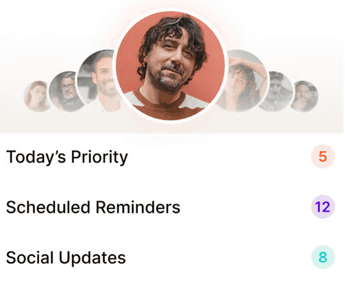
Each week, instead of trying to remember who you should be reaching out to, the AI hands you a short, prioritised list — usually 5–8 people. Already filtered by cadence, already loaded with context. You just send the messages.
5. Drafts starting points, not final words
Good AI relationship management will propose a conversation starter based on the person’s recent activity and your history. It doesn’t send it — you edit, adjust, make it sound like you, and send. The AI saves you the blank-page paralysis, not the voice.
The philosophy: human relationships, less admin
The best AI relationship management tools share one principle: AI handles the admin; humans handle the humanity. The goal isn’t to automate your warmth — it’s to remove the friction that stops you from expressing it.
“The surest way to become special in others’ eyes is to make them feel special.” — Dale Carnegie |
Dale Carnegie, a century ago, kept meticulous index cards with notes on every person he met — children’s names, projects, ambitions. He used them to make people feel remembered. AI relationship management is the 2026 version of those index cards. The discipline is the same. The admin is just smaller.
What the numbers say
82% of small businesses say referrals are their primary source of new business. Source: DemandSage, 2026 |
50% shorter sales cycles when a deal begins with a warm introduction. Source: Harvard Business Review / Influitive |
70% of a conversation is forgotten within 24 hours. AI-assisted notes catch it before it fades. Source: Research on human recall |
If your pipeline depends on warm relationships, the tool that lets you maintain more of them — without more hours — is the tool that shows up in your revenue. AI relationship management turns hours of admin into seconds.
A story from before AI existed
Kameron Thorne had been an active BNI member for five years. His referral network was strong, his business was thriving. When it got too busy, he decided to step back from his weekly networking rituals. Inside twelve months, he lost 48% of his revenue.
Not because of a bad market or a product issue. Because the referral network he had spent five years building quietly faded without active maintenance. The people who had sent him business moved on to other relationships. The network, left dormant, got quieter.
48% of revenue lost in a single year after a networker stepped back from the weekly habit. Source: Kameron Thorne, via BNI Podcast |
AI relationship management is the layer that makes it much harder for this to happen. It notices who you haven’t spoken to, surfaces signals, and keeps the rhythm going — even when your week is on fire.
What it doesn’t do (and shouldn’t)
A few things AI relationship management tools should never do. If a tool promises any of these, run.
Auto-send messages on your behalf. The human voice is the whole point.
Manipulate contacts. This is a relationship tool, not a sales hose.
Scrape private data you don’t have permission to use.
Replace the actual conversation. Warmth is a human thing.
The good tools stay strictly on the admin side. They capture, remember, remind, and suggest. You stay in charge of what gets sent, to whom, and when.
Why AI is finally good enough for this job
The reason this category exists in 2026 and didn’t five years ago is a pile of small capabilities crossing thresholds at roughly the same time.
Business card and document OCR is near-perfect, even on bad lighting.
Voice transcription is reliable enough to replace typing after a call.
Large language models can summarise a conversation, tag themes, and draft a plausible first-line starter in seconds.
Signal detection across LinkedIn, the web, and calendar data has matured enough to surface genuinely useful triggers.
All of this fits inside a phone, which is where you actually are when you meet new people.
For years, “build a relationship tool” was a good idea blocked by unreliable tech. In 2026, the building blocks finally work. That’s why AI relationship management is a real category now — not a future concept.
Who benefits most from AI relationship management
AI relationship management is most useful for professionals whose growth depends on relationships staying warm over time.
If your opportunities come through referrals, repeat business, clients, or long-term connections, this is where AI creates the biggest advantage.
Consultants and freelancers
Your pipeline is your network. AI relationship management keeps it warm with almost zero admin overhead.
Founders and executives
Investors, advisors, board members, candidates. Many relationships, all important, none of them fitting neatly in a sales CRM. AI-assisted personal CRMs cover this perfectly.
Sales professionals
Your company CRM tracks deals. AI relationship management layers onto the long-term relationship side — champions, past clients, referrers — that feeds the pipeline in year two, three, five.
Recruiters
Mandates go into your ATS. The broader candidate and client network — the one that produces the next mandate — lives in AI relationship management.
Real estate agents
A book of business is built on relationships that go dormant easily. AI cadence, signals, and context are the difference between a fading book and a growing one.

The weekly rhythm with AI doing the heavy lifting
AI relationship management works best as a small weekly habit, not a full-time task.
With AI handling the admin and reminders, staying consistent with your network fits into a simple 30-minute routine.
A realistic 30-minute AI-assisted networking block Open the app. The AI has prepared a list of 5–8 people to reach out to. For each, skim the context: last conversation, their recent activity, suggested conversation starter. Edit each message to sound like you. Send. Add any new people you met this week — scan a card, leave a voice note, AI fills in the rest. Optional: ask the AI to surface one intro opportunity — two contacts who should know each other. |
Over a year, this produces around 150 meaningful touchpoints. If you tried to do it by hand, it would take four times as long and still miss things. With AI doing the admin, it fits inside one coffee.
The give-first default, with AI on your side
The biggest risk in any networking tool is using it to extract value from people. AI relationship management is no exception. The best way to avoid that trap is to keep the ratio right.
“Real networking is about finding ways to make other people more successful.” — Keith Ferrazzi, Never Eat Alone |
80% of your outreach should be giving — sharing articles, congratulating, introducing, offering help. 20% can be asks. With AI, both sides get easier. It notices when someone posted something relevant so you can congratulate them. It remembers who you promised intros to and reminds you to follow through. The giving becomes systematic, not sporadic.
Regards: AI relationship management, built to stay human
Regards is a mobile-first AI relationship management tool designed for professionals whose work depends on relationships. Scan business cards, leave voice notes, and the AI handles the admin — transcribing, tagging, and setting follow-ups. Each week, Regards delivers a prioritised list of 5–8 people to reach out to, with context, signals, and suggested conversation starters. You send the messages. The warmth stays yours. See how it works at regardsapp.ai

Why we built Regards
I’m bad at staying in touch. Not because I don’t value people. Its a lot of work, and I didn’t have a system. This started as my fix. A quiet assistant that helped me nurture relationships thoughtfully. When people noticed the difference and asked what I was doing, it slowly evolved into a product. And the love has been incredible. Regards, Khuze

Frequently Asked Questions
What is AI relationship management?
AI relationship management is the use of AI to remove the admin from staying in touch with your professional network — capturing contacts, remembering context, surfacing signals, and preparing outreach. The AI handles the busywork; you handle the actual relationships.
How is AI relationship management different from a traditional CRM?
A traditional CRM tracks deals in a sales pipeline. AI relationship management is focused on one-to-one relationships over long horizons, and uses AI to remove the data entry and memory work that usually makes relationship tracking fall apart. Different user, different goal, different cadence.
Does AI relationship management replace human interaction?
No. It removes the reasons people usually stop staying in touch — the admin, the missed signals, the forgotten context — so you can spend more of your time on actual conversations, not less.
Is AI relationship management safe and private?
Good tools are built around private data by default — your notes, your contacts, your conversations. They don’t auto-send messages on your behalf and don’t share your network data with other users. Always check a tool’s privacy policy before uploading contacts.
Who should use AI relationship management?
Anyone whose work depends on a network — consultants, freelancers, founders, sales professionals, recruiters, real estate agents, agency owners, and anyone rebuilding or growing a professional network. If you find yourself thinking “I meant to follow up with X” more than once a month, you’re the target user.