

Picture the Sunday night you first realize your side hustle is turning into something real. A single project you delivered last year has quietly been working in the background. The client you did it for told two friends about you, and this month both of them signed on.
You are thrilled, and also a little cold in the stomach, because it just hit you that you never actually thanked the client who sent them your way, and there were a few other people you meant to follow up with whose names you honestly cannot remember anymore.
That moment is what this piece is about. Scaling business relationships is the quiet, unglamorous challenge of going full-time, and almost nobody warns you about it. Everyone talks about savings, pricing, and knowing when to quit your job. Far fewer people talk about what happens to your network when it starts growing faster than your head can hold it.
Key takeaways• In a side hustle, your memory is your CRM. Scaling is the exact moment it stops working. • Referrals become your main growth channel right when you have the least time to nurture them. • Going full-time means you lose your day-job network, so your own network becomes the lifeline of the business. • The people who make the leap build a simple system for staying in touch before their memory taps out. • You do not need to remember more. You need to rely on your memory less. |
The side hustle stage: your memory is your CRM
When you are starting out, your whole network fits comfortably in your head. You have a handful of clients, a few people who send work your way, and maybe one person you message whenever you are stuck. You remember every conversation because there are few enough of them to remember.
This works, and it works beautifully. It is also the trap. It quietly teaches you that relationships run on memory and goodwill alone, and that lesson stops being true at the worst possible time.
The tipping point: when your network outgrows your head
Then the volume changes. A good month brings ten new contacts instead of two. One happy client refers you to two more. You are delivering work, sending invoices, answering emails, and somewhere in all that noise the follow-ups start slipping.
Picture it. A past client emails to say a friend of theirs needs exactly what you do. You reply, you mean to circle back with the details, and then a deadline swallows the whole week. You just ran out of head space, and a warm introduction quietly went cold.
This is the real crisis of scaling business relationships, and it almost never announces itself. There is no alert when a relationship goes quiet. You only notice the referrals that stopped arriving, usually months after the trail went cold and long after you could have done anything about it.
The full-time stage: relationships become the business
When you go full-time, two things happen at once, and together they change everything.
First, you lose the passive network that came with a day job. No more colleagues, no more built-in introductions, no more people who knew your work without you having to explain it. Your own network stops being a nice-to-have and becomes the lifeline of the business.
Second, referrals become your main growth channel. They are cheaper and they close faster than any cold outreach, so they quickly turn into the thing your revenue depends on. And they arrive at the precise moment you have the least time to tend the relationships that produce them.
That is the paradox of scaling. Your relationships matter more than they ever have, and you have less capacity than ever to keep them warm. Willpower does not close that gap. A system does.
Stage | How you keep track | Main growth channel | What quietly breaks |
Side hustle | Your memory | Word of mouth you can recall | Nothing yet, which is the trap |
Tipping point | Memory and scattered notes | Referrals you sometimes miss | Follow-ups slip through the cracks |
Full-time | A system you actually keep | Referrals, nurtured on purpose | Only what you choose to let go |
How to scale business relationships without dropping the ball
The fix is not to become superhuman about memory. It is to stop depending on memory at all. A few moves make the jump survivable, and none of them take much time.
Capture context outside your head.
The moment you can no longer hold every detail, write it down somewhere you will actually see it again. What someone is working on, what they mentioned last time, when you spoke. This one habit removes most of the fear of forgetting.
Prioritize by who matters now, not who you like most.
As the network grows, decide each week on the small set of people worth reaching out to, and let the rest wait without guilt. A short, honest list beats a long, anxious one.
Keep a light, regular rhythm.
A handful of genuine touches every week does more than a heroic catch-up binge twice a year. Consistency, not intensity, is what keeps a big network warm.
Let referrals compound on purpose.
Thank the people who send you work, tell them how it turned out, and keep them close. Referrals grow when the people making them feel seen.
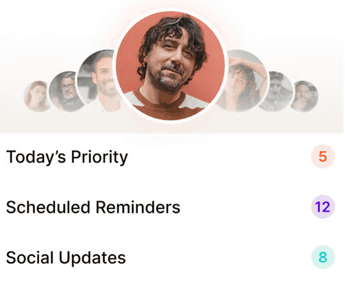
This is exactly the job a business growth CRM is meant to do for you. Regards keeps your people and your context in one place, and each week it hands you a short list of who to reach out to and what to say, so staying close to a growing network takes about five minutes a day instead of a Sunday full of dread.
The short version
When your business is a side hustle, your network fits in your head. Scaling is the moment it stops fitting. The people who make the leap are not the ones with better memories, they are the ones who turned staying in touch into a simple system before their memory tapped out.
Do that early, while your network is still small enough to handle by hand, and growth stops quietly costing you the relationships that made it possible in the first place.

Why we built Regards
I’m bad at staying in touch. Not because I don’t value people. Its a lot of work, and I didn’t have a system. This started as my fix. A quiet assistant that helped me nurture relationships thoughtfully. When people noticed the difference and asked what I was doing, it slowly evolved into a product. And the love has been incredible. Regards, Khuze

Frequently Asked Questions
How do you maintain business relationships as your company grows?
Stop relying on memory and start relying on a system. Capture context about people somewhere you will see it again, decide each week on a small group to reach out to,
Do I need a CRM when my business goes full-time?
Usually, yes. The point you go full-time is the point your network outgrows your head and referrals become your main growth channel. A CRM gives you one place to hold your people and your context so nothing slips, which matters most exactly when you have the least time.
What is a business growth CRM?
A business growth CRM helps you keep and grow the relationships that drive revenue as you scale, rather than just storing contact details. Tools like Regards go further by telling you who to reach out to each week and what to say, so staying in touch becomes a habit.
Why do relationships get harder to manage as a business scales?
Because the number of people grows faster than your ability to remember them. In a side hustle you can track everyone by memory. As volume rises, follow-ups slip silently, and there is no alert when a relationship goes cold, so you only notice once the referrals stop.
How do you keep a growing network feeling personal?
Keep context on the people who matter, reach out on a rhythm rather than only when you need something, and make your touches genuine and spaced out. Personal does not mean remembering everything yourself, it means showing people you remembered them.