
Key Takeaways
|
What AI Relationship Prediction Actually Looks At
AI relationship prediction sounds like it should be mysterious, but the inputs are pretty grounded. It's reading behavior — yours and theirs — at a scale you couldn't track in your head across a few thousand contacts. The core inputs usually fall into four categories:
Recency and frequency — how long it's been since you last connected, and whether that gap is widening.
Mutual engagement — whether your outreach gets replies, not just whether messages get sent.
Referral and introduction history — who has sent you business or connections before, which is often the strongest predictor of who will again.
External signals — a role change, a new company, a relevant post, or overlap with the kind of client or partner you're trying to reach.
How Predictive Analytics CRM Tools Spot Your Highest-Value Contacts
The most useful thing a predictive analytics CRM does is catch the people you'd otherwise miss. None of the examples below show up if you're relying on memory or a static contact list — they show up when something is actively comparing your network's current behavior to its history and flagging what's changed.
Signal | Why it matters |
|---|---|
Referral source gone quiet | Past introductions are the strongest predictor of future ones — a lapse is worth catching early. |
Past client changed companies | A natural, low-pressure reason to reconnect before they establish new vendor relationships. |
Contact posted a hiring or funding update | A timely, specific reason to reach out that isn't a cold check-in. |
Engagement dropped over recent months | Quiet disengagement is easier to reverse the earlier it's caught. |
Met at a conference, no follow-up yet | The window for a first follow-up to feel natural is short and easy to miss. |
The AI Insights Worth Paying Attention To
Not every insight is useful, and it's easy to end up with a dashboard full of numbers that don't tell you what to do next. A "relationship health score" that just sits there isn't worth much. An insight that says "reach out to this person, they mentioned a promotion last week" is. The difference is specificity: does it tell you who, and does it tell you why, in plain language you could act on in the next five minutes.
Relationship Scoring: Useful Signal, Not the Whole Story
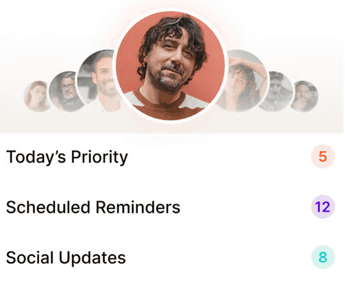
Relationship scoring can be a genuinely helpful way to prioritize a long list of contacts. But a score can't capture trust, history, or the fact that someone just went through a hard year and now isn't the moment to pitch them anything. Treat scoring as a way to sort your list, not as the final word on who matters. The people who use this well still apply their own judgment on top of it — the AI narrows the field, you make the call.
Getting Started: Turning Prediction Into a Weekly Habit
Prediction is only useful if it turns into action. Here's a simple way to start using it without overhauling how you work:
Connect your existing network. LinkedIn, email, or a spreadsheet — the prediction gets more accurate the more history it has to learn from.
Flag your priority relationships. Referral sources, past clients, and key contacts you don't want to lose touch with, so the system weighs them correctly.
Review your daily list each morning for a week. Notice which suggestions feel obvious versus which ones surface someone you'd genuinely forgotten.
Act on at least 3-5 of the flagged contacts. The value only shows up once you've tested whether the timing and reasoning actually hold up.
Adjust what you're tracking as your priorities shift. A new target market or a change in focus should change who gets flagged.

Why we built Regards
I’m bad at staying in touch. Not because I don’t value people. Its a lot of work, and I didn’t have a system. This started as my fix. A quiet assistant that helped me nurture relationships thoughtfully. When people noticed the difference and asked what I was doing, it slowly evolved into a product. And the love has been incredible. Regards, Khuze

Frequently Asked Questions
How does AI predict which relationships matter most?
By analyzing patterns like contact frequency, mutual engagement, referral history, and signals such as job changes — then flagging contacts whose importance or risk of going cold has changed.
Is relationship scoring accurate?
It's a useful directional signal, not a precise measurement. It's best used to prioritize who to reach out to first, alongside your own judgment about the relationship.
Can AI tell me who's about to become a client or referral source?
It can surface signals that make someone more likely to be worth reaching out to now — a role change, renewed activity, or a relevant post — but it can't guarantee outcomes.
Do I need a lot of contacts for AI predictions to be useful?
It helps at scale, but even a network of a few hundred contacts benefits, since most people can't reliably track more than a handful of relationships by memory alone.
What's the difference between relationship scoring and a regular CRM tag?
A tag is something you set manually and rarely update. A score updates on its own as behavior changes, so it stays current without extra data entry.
How quickly do predictions become accurate?
Expect it to improve over the first couple of weeks as the system observes more of your actual interactions — early suggestions are a reasonable starting point, not the final word.
How does Regards use prediction differently?
Instead of a dashboard of scores, Regards turns prediction into a short, specific daily list of who to reach out to and why.