

If you’ve ever looked at your LinkedIn and felt a tiny wave of guilt at how many people you meant to stay in touch with, this post is for you. Almost everyone has this problem. Almost nobody has a system for it.
Here’s the good news: maintaining professional relationships is a skill, not a personality trait. You don’t need to be an extrovert or a relentless networker. You need a system simple enough that you’ll actually use it on a Wednesday when you’re tired.
Key takeaways
|
The reason relationships fade (and it’s not what you think)
Most professional relationships don’t end because of a falling-out. They don’t end because of distance or conflict. They end because of neglect — the quiet drift of two people who liked each other but never made the next touchpoint a priority.
“A relationship at rest will remain at rest unless acted upon with intention.” — Ivan Misner, Founder of BNI |
You had a great conversation. You meant to follow up. A month passed. Now it’s awkward. Another month passed. Now it’s weird. Another month passed. Now it’s a memory. Multiply that by every warm contact you’ve made in the last five years, and you have the actual shape of most people’s networks.
48% of revenue one BNI member lost in a single year after stepping back from his networking habits. Networks fade faster than people realise. Source: Kameron Thorne, via BNI Podcast |
The fix isn’t “try harder.” Trying harder is why people burn out and go quiet for six months. The fix is a system simple enough to survive a busy week.
The one principle that makes it sustainable
Before you worry about cadence, apps, or templates: get the ratio right.
Roughly 80% of your touchpoints should be giving value to the other person. 20% can be about you. If you flip that ratio, no cadence will save you — you’ll just feel pushy at scale. If you get it right, no cadence will feel pushy — people will be genuinely glad to hear from you.
“Real networking is about finding ways to make other people more successful.” — Keith Ferrazzi, Never Eat Alone |
Adam Grant’s research, across 30,000 professionals in multiple industries, found that the most successful people in almost every field are the most consistently generous ones. Not naive givers — strategic ones who protect their time but help broadly. The takers end up last. The matchers (who only give when they expect something back) plateau. The givers, once they learn boundaries, dominate the top.
The cadence framework that takes the guessing out
“How often should I reach out?” is the question that keeps people stuck. Here’s a simple framework that removes the anxiety.
The cadence framework — by relationship tier Inner Circle (10–20 people): real conversation every 2–4 weeks. Call, coffee, voice note, or personal message. Active Network (50–150 people): a short, targeted touchpoint every 6–8 weeks. Article, congrats, a check-in that references something specific. Extended Network (100–300 people): low-effort, high-warmth contact every 3–6 months. Birthday note, comment on a post, “thinking of you.” New connections: follow up within 24–48 hours of meeting. Reference something specific. Suggest a small next step. |
The numbers aren’t magic. The point is that different relationships deserve different cadences, and once you’ve decided on the cadence you’ll use, the app or the calendar does the reminding. You stop carrying it in your head.
The 30-minute weekly block
Every networking expert — Ferrazzi, Misner, Grant, Carnegie — ends up recommending a version of the same practice: a fixed, recurring block of time each week dedicated to maintaining your network. Not “when I have a free moment.” Scheduled. Non-negotiable. Brief enough to actually do.
The 30-minute weekly networking ritual Open your personal CRM or contacts app. Look at who’s overdue based on your cadence. Send 3–5 messages: a check-in, a shared resource, a congratulations, a re-engagement. Follow up on any commitment you made last week — an article you promised, an intro you offered. Add any new people you met this week. Set their cadence. Add notes while fresh. Optional: make one introduction between two people in your network who should know each other. |
Over a year, that 30-minute block compounds into something remarkable: about 150 meaningful touchpoints. 150 moments where someone felt remembered, valued, and considered. That is the entire discipline.
The note-taking habit almost no one has
Keith Ferrazzi argues that note-taking after conversations is the single most under-practised networking habit. Not elaborate notes — just enough to remember what mattered to someone.
“Friendship is created out of the quality of time spent between two people, not the quantity. A single deeply attentive conversation can do more than a hundred hollow check-ins.” — Keith Ferrazzi, Never Eat Alone |
Dale Carnegie, a century before Ferrazzi, made this his entire method. He kept meticulous notes on the people he met — what they cared about, their children’s names, the thing they were working on. He used those notes to make people feel, the next time they met, like the most important person in the room. That wasn’t manipulation. It was the systematic application of genuine attentiveness.
What to log after every meaningful conversation What they’re currently working on or excited about Any personal detail they mentioned (family, a trip, an ambition) Their biggest current challenge Any promise or commitment you made How you can be useful to them next time |
The next time you reach out, you get to say: “How did the Berlin trip go?” or “Did the hiring round end up working out?” People almost never expect this level of recall. It’s the clearest possible signal that you see them as a person, not a contact.
Re-engaging the people you’ve already lost touch with
If you’re reading this and thinking “great, but I’ve already let dozens of people drift” — welcome to the club. Everyone has dozens of people they’ve let drift. The good news: dormant relationships are easier to revive than most people realise.
“Dormant ties are the most potent people in your network. They think and act differently than you. They’re in different circles. But it’s far easier to re-establish rapport — because you already had it once.” — David Burkus, Friend of a Friend |
Research on dormant ties — relationships that were once close and have faded — consistently shows that the trust is still there, and reactivating one is far faster than building rapport from scratch with a stranger. You just need a thoughtful, low-pressure way back in.
The three-step dormant re-engagement Find the hook — a recent post, a job change, a mutual announcement. Not “it’s been a while.” A real reason. Keep it short — three sentences. Reference the hook. Show genuine interest. No ask in message one. Rebuild before you need — reconnect during calm periods. A relationship reactivated when you have nothing to ask is worth ten times more than one where your first message in three years is a favour. |
One dormant tie a week, re-engaged thoughtfully, is 50 revived relationships a year. That’s a whole network.
Five things to send when you don’t know what to say
This is the frozen moment that trips most people up. They sit down to reach out and draw a blank. Here’s the menu.
A relevant article or resource, with one line on why you thought of them
A congratulations on a post, promotion, or company news
An introduction to someone in your network they’d enjoy knowing
A follow-up referencing something they told you last time (“how did the Berlin trip go?”)
A simple “thinking of you — hope [personal thing they mentioned] is going well”
None of these are pitches. None require you to have news. They require you to have paid attention. That’s the entire art.
What not to do
Most relationship management fails through small habits that slowly make your outreach feel generic, transactional, or forgettable.
Avoiding these mistakes matters just as much as sending the right follow-up in the first place.
Don’t save up and send five emails at once
Batch-processing your network in a burst of guilt is a reliable way to feel like you’re “networking” and still send messages that are generic. Spread it out. Three messages on Monday is better than fifteen on a Sunday night.
Don’t use the word “touch base”
“Just wanted to touch base” is the universal signal that no actual thought went into the message. If there’s no specific reason, there’s no specific message. Find the reason first.
Don’t pitch when you mean to check in
If you haven’t spoken in a year and your first message is selling something, you’ve confirmed every fear a person has about professional relationships. One warm touchpoint — often two or three — before anything resembling an ask.
Don’t rely on memory
The one thing every successful networker shares: they stopped trying to hold their network in their head. Notes, reminders, and cadence — carried by a tool — are the reason it works consistently over years, not just in good months.
A good tool takes the admin off your plate
You can do all of this with a notebook and a calendar. Some people do. But the three things that break down without a tool are: knowing who’s overdue, remembering context before a message, and noticing the signals that make outreach land (job changes, launches, birthdays).
A personal CRM or networking app handles all three. It isn’t magic — it’s just the right list, with the right context, at the right time. You bring the humanity.
How Regards makes maintaining relationships a 30-minute weekly habit
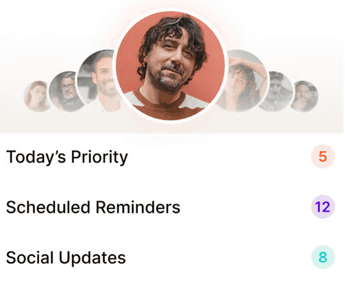
Regards is built specifically to make this work sustainable. Every week, it hands you a short, prioritised list of 5–8 people to reach out to, with context from your last conversation and suggested conversation starters based on their recent activity. Scan a business card, leave a voice note — the AI extracts the follow-ups. You spend your time on the humans, not the admin. Learn more at regardsapp.ai

Why we built Regards
I’m bad at staying in touch. Not because I don’t value people. Its a lot of work, and I didn’t have a system. This started as my fix. A quiet assistant that helped me nurture relationships thoughtfully. When people noticed the difference and asked what I was doing, it slowly evolved into a product. And the love has been incredible. Regards, Khuze

Frequently Asked Questions
How do I maintain professional relationships when I’m busy?
Set a cadence per relationship tier. Block 30 minutes a week to act on it. Use an app to track who’s overdue and surface context. Keep messages short, specific, and giving-first. That’s the whole system.
How often should I reach out to maintain a professional relationship?
Inner-circle relationships: every 2–4 weeks. Active network: every 6–8 weeks. Extended network: every 3–6 months. New connections: within 24–48 hours of meeting. Adjust based on signals like posts, job changes, or big life events.
What should I say when I reach out to someone after a long time?
Reference something specific from their world — a post, a job change, a company announcement. Keep it to three sentences. Express genuine interest. Do not make an ask in the first message. You’re rebuilding warmth, not cashing a chip.
What’s the best way to keep track of professional contacts?
Use a personal CRM or networking app that lets you add notes, set cadence reminders, and surface context before you reach out. Spreadsheets work for a while; they tend to break down once you pass a few hundred contacts.
How do I get back in touch with someone I’ve lost touch with?
Find a genuine hook (a recent post, a milestone, a mutual connection). Send three sentences. Reference the hook, express interest, skip any ask. Reconnect during a calm period, before you need anything. Dormant ties are easier to revive than most people expect — the trust is usually still there.