

Here’s the fear almost every service business owner carries around: if you keep reaching out, you’ll be annoying. If you don’t, you’ll be forgotten. So you do neither, and slowly drift out of people’s orbit anyway.
Good news: you’re not choosing between annoying and invisible. There’s a third option, and it’s actually closer to invisible — thoughtful, quiet, consistent touchpoints that keep you in someone’s mind without ever feeling like you’re “networking at” them.
This post is the playbook.
Key takeaways
|
Why staying top of mind is the actual game
Most professionals get the importance of relationships and then get the execution wrong. They go quiet for six months, then show up with a bid or a proposal. The client signs with someone else — often someone less talented — because that someone stayed visible.
82% of small businesses say referrals are their primary source of new business. Source: DemandSage, 2026 |
50% shorter sales cycles when a deal starts with a warm introduction. Source: Harvard Business Review / Influitive |
When a client is ready to buy, hire, or refer, they pick who comes to mind first. Not who is the best on paper. Not who sent the most emails. Whoever crossed their mind most recently, with warmth. That’s the whole game.
“Dig your well before you’re thirsty. The time to invest in relationships is before you need them — not during a crisis when everyone can feel the desperation.” — Ivan Misner, Founder of BNI |
The cautionary tale: what happens when you go quiet
Kameron Thorne had been an active member of BNI for five years. His business was thriving. His referral network was healthy. Things were busy enough that he decided to step back from his networking habits — just for a bit.
Within twelve months, he had lost 48% of his revenue.
Nothing about his product or market had changed. What had changed was that the people who used to think of him first, when a lead came in, now thought of somebody else. The network, left dormant, had faded.
Thorne’s line, since: “A network isn’t a passive asset you can draw on whenever you like. It’s a living system. It grows when you tend it, and it fades when you don’t.”
The rule that separates thoughtful from annoying
Here’s the one principle that changes everything. Give first. Ask rarely. Don’t keep score.
“Real networking is about finding ways to make other people more successful.” — Keith Ferrazzi, Never Eat Alone |
If 80% of your touchpoints are value to them — an article, a congratulations, an intro, a relevant thought — and 20% are about you (a quarterly update, a candid ask when one is warranted), you’re invisible in the best way. You’re a person people are glad to hear from.
If 80% of your touchpoints are asks — referrals, follow-ups, proposals, “wanted to touch base” — you are exactly the person everyone is quietly trying to ghost.
Nearly all “being annoying” is the second pattern, not the first. The frequency is almost never the problem. The ratio is.
The Five-Minute Favour: your new weekly unit of work
Adam Rifkin was named by Fortune as the best-connected person in Silicon Valley. He doesn’t work a room. He’s an introvert. His whole method is something Adam Grant calls the “Five-Minute Favour” — small acts of generosity that take no more than five minutes each, delivered consistently over time.
Five ways to give in five minutes or less Forward an article, report, or resource you know they’d find valuable. Introduce two people in your network who should know each other. Leave a public endorsement or recommendation on their LinkedIn profile. Share their content, event, or product with your own network — no ask attached. Reply to an old thread with a contact, resource, or quick answer to a problem they mentioned. |
This is the actual, unglamorous atom of world-class networking. Five minutes. Repeated. With no score kept.
“You don’t need to do something grand to build a great network. You just need to be consistently generous in small ways, to a lot of people, over a long time.” — Adam Rifkin, via Adam Grant’s Give and Take |
A realistic cadence — so you’re not guessing
“How often should I reach out?” is the most common question, and the honest answer is: it depends on the relationship. The easiest way to stop feeling anxious about it is to define a cadence up front and then trust the system.
A research-backed cadence by relationship tier Inner circle (10–20 people): real conversation every 2–4 weeks. Call, coffee, voice note, meaningful message. Active network (50–150 people): short, targeted touchpoint every 6–8 weeks. Article, congrats, comment, “how’d that go?” Extended network (100–300 people): low-effort, high-warmth contact every 3–6 months. Birthday note, “thinking of you,” comment on a post. New connections: follow up within 24–48 hours. Reference something specific. Suggest a small next step. |
Pick your groups. Pick your cadence. Let an app or a calendar carry the tracking. The moment you stop trying to keep this in your head, the anxiety about being “annoying” dissolves.
Eight low-pressure things to send
If you’ve ever opened a fresh email window and stared at it because “I don’t have anything to say,” here’s your menu.
A relevant article, with one line on why you thought of them
A congratulations on a promotion, launch, or milestone they posted
An introduction to someone in your network they’d benefit from knowing
A “how did the [thing] go?” referencing something from your last conversation
A public comment or share of their recent post (sometimes that’s the whole touchpoint)
A resource — template, report, tool — that maps to something they mentioned
A quick thought on something they said that’s been rattling around in your head
A simple “thinking of you — hope [life thing they mentioned] is going well”
None of these are pitches. None of them are “circling back.” None of them require you to have any news. They require you to have been paying attention.
The message that signals “I was listening”
Dale Carnegie, writing in the 1930s, noticed that the deepest human craving is to feel important and genuinely understood. He spent his whole career arguing that the most powerful thing you can do with another person is make them feel truly heard.
The fastest way to do that in a follow-up: reference the specific thing they told you last time. Their daughter’s recital. The book they were reading. The launch they were nervous about. The conference they mentioned hating. The cofounder conversation they were working through.
Almost no one does this. Most people send “just checking in,” which says “I didn’t actually remember anything specific about you.” Being the exception takes one tiny discipline: write down the specifics after every conversation, and pull them up before you reach out.
“The surest way to become special in others’ eyes is to make them feel special.” — Dale Carnegie |
What to log after every meaningful conversation What they’re currently working on or excited about Any personal detail they mentioned (family, health, a trip, an ambition) Their biggest current challenge or problem Any promise or commitment you made How you could be genuinely useful to them next time |
What not to do
If your goal is to build long-term trust, these are the habits to avoid. Most relationships don’t break through one big mistake — they fade through small interactions that feel generic, transactional, or insincere over time.
Don’t send bulk “updates” that aren’t updates
The quarterly “what’s new with me” email that nobody asked for. Almost always feels like marketing, even when you mean well. If you’re going to send a group message, make 80% of it actually useful to the reader — a roundup of good resources, a genuine lesson, a link to something they’d enjoy — with a small footer about you.
Don’t weaponise LinkedIn
Auto-likes. Auto-comments. “Hope you’re well, just wanted to connect regarding…” DMs. People can tell. The backlash against synthetic outreach is real, and it’s costing the senders real trust.
Don’t lead every re-engagement with a pitch
The “haven’t spoken in a year, here’s my new service” message is the single most common way to burn a warm tie. One warm touchpoint first. Ideally two or three. Then, if an ask is natural, ask.
Don’t silently ghost and hope nobody notices
If you’ve been quiet for a while, the way back in is not awkward — it’s almost always welcome. “Hey, been meaning to reach out — saw you posted about [thing] and it made me think of you.” That’s it. Most people are secretly relieved someone broke the silence.

The 30-minute weekly block
Here’s the only habit you actually need to make all of this work. Pick a consistent 30-minute slot each week. Same time, same place, same drink. Treat it like a meeting with a client — because in effect, it is.
What to do in your 30-minute weekly networking block Open your personal CRM or networking app. Review who’s overdue for a touchpoint based on your cadence. Send 3–5 messages: a check-in, a shared resource, a congratulations, a re-engagement. Follow up on any commitment you made last week — article, intro, answer. Add any new people you met this week. Set their cadence. Get your notes in while fresh. Optional: make one introduction between two people in your network who should know each other. |
Over a year, that’s roughly 150 meaningful touchpoints — 150 moments where someone felt remembered, valued, and considered. That’s the entire secret. There is no other secret.
What an app actually adds
You can do all of this in a notebook. People have. But the three things you cannot easily do in a notebook are: remember who’s overdue, pull up context before reaching out, and notice the signals that make outreach land (job changes, launches, anniversaries).
A good relationship management app or personal CRM app handles all three. It’s not magic. It’s just: every Monday, the list of who to message is waiting for you, with the context you need and a suggested reason to reach out. You spend your 30 minutes on the humans, not the admin.
How Regards helps you stay top of mind
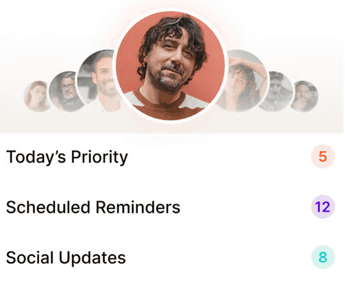
Regards is the app that actually helps you stay top of mind with clients — without the spam tactics. Every week it gives you a prioritised list of 5–8 people to reach out to, based on cadence, recency, and real signals like LinkedIn posts, job changes, and anniversaries. Each one comes with context from your last conversation and a suggested conversation starter. You send the message — personally, from your own accounts. The AI handles the remembering. Try it at regardsapp.ai

Why we built Regards
I’m bad at staying in touch. Not because I don’t value people. Its a lot of work, and I didn’t have a system. This started as my fix. A quiet assistant that helped me nurture relationships thoughtfully. When people noticed the difference and asked what I was doing, it slowly evolved into a product. And the love has been incredible. Regards, Khuze

Frequently Asked Questions
How do you stay top of mind with clients without being annoying?
Keep the ratio right: roughly 80% of your touchpoints should give value to them (an article, a congrats, an intro, a thoughtful note), and 20% can be about you. Match the cadence to the relationship tier. Always reference something specific, so each message feels personal rather than like a bulk send.
How often should I reach out to clients and prospects?
Rough rule: inner-circle clients every 2–4 weeks (real conversation), active network every 6–8 weeks (short targeted touch), extended network every 3–6 months (light, warm contact). New connections: within 24–48 hours of meeting.
What app helps you stay top of mind with clients?
Look for a mobile-first personal CRM or networking app that surfaces who to reach out to each week, captures voice notes and business cards, and pulls in signals like job changes and LinkedIn posts. Regards is built specifically for this job.
What do I say when I haven’t spoken to someone in a long time?
Reference something specific — a recent post, a job change, a mutual connection, a piece of news. Three sentences. Show genuine interest. Do not ask for anything in the first message. You’re rebuilding warmth, not cashing in a chip.
Is it annoying to reach out too often?
Usually not — if the ratio of value-to-ask is right. People rarely complain about receiving a useful article or a thoughtful check-in. They complain about receiving bulk updates, vague “how are you” messages, and pitches dressed as catch-ups. Frequency is almost never the problem. Content is.