

Cold outreach is hunting. Staying in touch with your network is farming. For most of the 2010s, hunting worked well enough that farming felt optional. In 2026, that equation has flipped. Inboxes are full, open rates are down, and cold audiences are less responsive than at any point in the past decade. Meanwhile, the professionals who maintained consistent relationships through all of it are receiving referrals at a rate that no paid channel can match.
Key Takeaways
|
The Hunting Model: What It Is and Where It Still Works
Hunting is the acquisition of new business through outreach to people who do not yet know you: cold email, paid advertising, content marketing to broad audiences, cold calling, or conference prospecting with no prior relationship. At scale, with the right funnel, it can work.
Where it works best: businesses with high transaction volume, standardised offerings, and the budget to run and optimise acquisition campaigns. A SaaS company targeting mid-market buyers, a direct-to-consumer brand, or an agency with a clear offer and high enough margins to fund paid acquisition.
Where it struggles: professional services businesses where trust is a prerequisite, solo operators without marketing infrastructure, and any context where the client relationship is the product. Here, hunting is expensive, slow, and produces clients who take longer to trust you than clients who were referred.
The Farming Model: Why It Outperforms for Professional Services
Farming is the cultivation of relationships that already exist — clients, past clients, referral partners, warm contacts — with the goal of generating repeat business and referrals. It is slower to set up and invisible in the short term. In the medium term, it is the most powerful growth model most professional services businesses have access to.
The math is not subtle. A referred client converts at 20–40%. They close faster. They have lower price sensitivity because they come pre-sold on your value. They tend to have longer engagement lifecycles. And they refer in turn — creating compounding rather than linear growth.
The professionals growing fastest in 2026 are not the ones sending the best cold emails. They are the ones who have been farming their network consistently enough that referrals have become their primary pipeline.
The Data That Decides the Argument
Cold email open rates have declined from 20–25% in 2019 to 8–12% in 2025 across most B2B categories. Reply rates on cold LinkedIn messages are similarly compressed. Response rates to cold calls have fallen to below 5% in most professional contexts. The hunting channels are not dead — but they are dramatically less efficient than they were five years ago.
Warm referral conversion rates have remained stable or improved because they are fundamentally trust-based rather than channel-based. The trust was built before the conversation started. The quality of the connection matters more than the quality of the message.
The rational conclusion: for most professional services businesses, the farming model produces better clients at lower cost and higher conversion than hunting. The investment is in relationships, not campaigns.
Building a Farming System That Actually Works
The reason most professionals do not farm is not that they do not understand its value — it is that they do not have a system. Farming by memory fails at scale. You need a structured approach: a contact list with relationship tiers, touchpoint cadences for each tier, and a tool that surfaces who to reach out to and when.
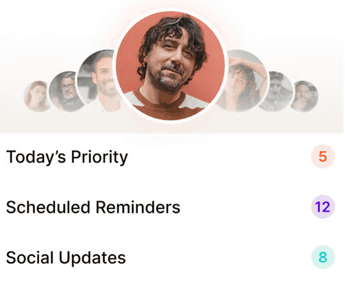
Regards is built for exactly this — proactive weekly outreach lists, conversation starters based on LinkedIn signals, and a lightweight mobile interface that fits the farming habit into a 5-minute daily routine.
The best strategy in 2026 is not hunting or farming exclusively — it is a mix that leans heavily toward farming as your relationships deepen, with targeted hunting used selectively for specific new audience segments. Start with the farming system. Build consistent relationship maintenance. The referrals follow.

Why we built Regards
I’m bad at staying in touch. Not because I don’t value people. Its a lot of work, and I didn’t have a system. This started as my fix. A quiet assistant that helped me nurture relationships thoughtfully. When people noticed the difference and asked what I was doing, it slowly evolved into a product. And the love has been incredible. Regards, Khuze
Frequently Asked Questions
Can you grow a business purely through farming without any hunting?
Yes, and many successful professional services businesses do. If referrals and repeat business from an existing network generate sufficient volume at sufficient quality, there is no strategic requirement for cold outreach. This is the mature model for many established firms.
How long does it take for farming to produce results?
The first results — re-engaged relationships, inbound referrals from consistent touchpoints — typically emerge within 60–90 days of systematic farming. The compounding effect builds over 12–24 months. Farming is a long-term investment with an accelerating return.
What is the best hunting strategy for a professional services business that needs immediate revenue?
Warm introductions are the fastest-converting form of hunting — asking your existing network to introduce you to specific types of people. This is technically hunting (reaching new contacts) but through warm channels, so it converts much faster than cold outreach.
Is cold outreach dead?
Not dead, but significantly less efficient than it was. Well-researched, highly personalised cold outreach still works for specific use cases. Spray-and-pray cold email does not. The bar for cold outreach that gets a response has risen substantially.
How do I convince my team to invest in farming when the results are not immediately visible?
Track referral sources. When a deal comes in, ask how they found you. Over time, the data shows clearly which relationships are producing business. Farming advocates in management teams almost always have the referral data to prove the case.