
Key Takeaways
|
What AI Contact Recommendations Actually Do
Most professionals sit on a network that's far more useful than they realize, simply because it's too large to hold in your head. AI contact recommendations exist to solve exactly that problem: looking across your full network to suggest who might be worth introducing, reaching out to, or reconnecting with, based on context you'd have to piece together manually otherwise.
This shows up most clearly around introductions. You might know someone hiring for a role and someone looking for one, without ever connecting the two, simply because you met them at different times for different reasons. Good contact recommendations exist to surface that overlap.
This matters more for some professionals than others. A headhunter with client and candidate relationships spread across years of searches, an agency owner whose past clients and vendors could genuinely use each other, a conference-goer whose new contacts overlap with people they already know from a different business group — in each case, the useful connections already exist somewhere in the network. The problem was never a lack of relationships. It was never having a reliable way to notice which ones belonged together.
Where Smart Recommendations Add Real Value
A few concrete examples of useful AI matching:
Introduction opportunities — flagging two contacts who could genuinely help each other, based on what they've each mentioned needing.
Re-engagement suggestions — surfacing a dormant contact whose current role now overlaps with who you're trying to reach.
Referral matching — identifying which of your existing contacts is best positioned to make an introduction you're looking for.
Good Contact Suggestions vs. Noisy Ones
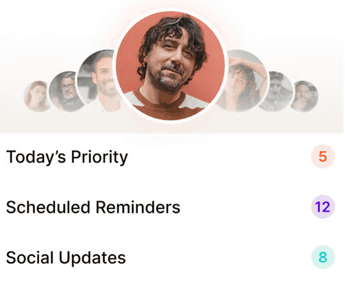
Not all AI matching is equally useful. The difference usually comes down to whether the suggestion is specific enough to act on.
Useful suggestion | Noisy suggestion |
|---|---|
"Introduce Sam to Priya — Sam mentioned needing a designer, Priya just went freelance" | "You might also know: Sam Lee" with no reason given |
Based on something recently mentioned or changed | Based purely on shared employer or location |
Suggests a specific action (introduce, reconnect, follow up) | Just surfaces a name with a vague relevance score |
Accounts for whether the relationship is currently warm | Suggests contacts you haven't spoken to in years with no context |
Making the Most of AI Contact Recommendations
A simple way to start putting this to use:
Keep your network in one place. Fragmented contacts across platforms make it harder for any matching to be useful.
Note what people are actually looking for. A quick note — "hiring a VP of Sales," "looking for design help" — makes future matching far more accurate.
Review suggested introductions weekly. Act on the ones with a clear, specific reason attached first.
Always check in with both sides before introducing. A quick "would it be useful if I connected you two?" respects everyone's time.
Update notes as things change. A contact's needs shift — keeping notes current keeps recommendations relevant.

Why we built Regards
I’m bad at staying in touch. Not because I don’t value people. Its a lot of work, and I didn’t have a system. This started as my fix. A quiet assistant that helped me nurture relationships thoughtfully. When people noticed the difference and asked what I was doing, it slowly evolved into a product. And the love has been incredible. Regards, Khuze

Frequently Asked Questions
How do AI contact recommendations work?
They look across your network for relevant overlaps — shared needs, recent activity, or context you've noted — and suggest specific people worth reaching out to or introducing.
Can AI suggest introductions I wouldn't have thought of myself?
Yes, that's often where it adds the most value — networks are usually too large to hold every possible connection in your head.
Is contact matching accurate?
It's a useful starting point, but it works best when paired with notes about what people actually need — the more context available, the more relevant the suggestions.
Will AI send introduction messages automatically?
It shouldn't. A good system surfaces the suggestion; you decide whether and how to make the introduction.
Do I need a huge network for this to be useful?
It helps at scale, but even a modest network benefits, since most people can't manually track every possible overlap between contacts.
How is this different from LinkedIn's "people you may know"?
LinkedIn's suggestions are based mostly on shared connections and employers. Relationship-focused AI recommendations account for context — what someone needs, recent activity, and relationship strength.
How does Regards handle contact recommendations?
Regards surfaces relevant reach-outs and introduction opportunities based on your network and the context you've captured, rather than generic "people you may know" style suggestions.