

Picture this: a managing partner at a boutique exec search firm placed a CFO eighteen months ago. The placement was clean. The retainer cleared. The CFO got promoted to COO last Tuesday. The post is sitting on LinkedIn with 240 reactions.
You don't see it. Your ATS doesn't see it. The CFO — now COO — doesn't hear from you. Six weeks later, when his board needs a head of finance, he calls the recruiter who reached out to congratulate him. That recruiter wasn't you.
Search is a relationship game played at the speed of LinkedIn notifications, and your ATS was never built for it. A personal CRM for headhunters is the layer that catches what the ATS doesn't.
Key takeaways• An ATS tracks the transaction. A personal CRM for headhunters tracks the relationship that produces the next transaction. • Eight signals are worth watching across your network: promotion, job change, fundraising, M&A, hiring post, conference appearance, podcast, milestone. • A personal WhatsApp message from your number beats any 'outreach automation' you've ever paid for. • Pre-call brief, post-call voice note, 30/60/90 follow-up. That's the loop a recruiter CRM should support. |
Why headhunters need a personal CRM
The strongest revenue in executive search comes from people you've already met. Past candidates who became hiring managers. Hiring managers who'll work with you on five searches over the next decade. Final-shortlist candidates who just moved into a head-of-function role. None of these moments sit cleanly inside an ATS workflow. They sit between processes.
A personal CRM for headhunters is the tool for the in-between. It's how you keep relationships warm when nothing transactional is happening, so the next time something is, you're the call that gets made.
Why your ATS is the wrong tool for the relationship layer
The ATS is a system of record for placements. It's optimized for one job at a time — stages, candidate pipelines, scorecards. The data model assumes a candidate is in a process or out of one.
But your real business runs in the negative space. The candidate you didn't place last year is your most likely client in two years. The CMO you got to a shortlist and lost to an internal hire just left for a new company. The hiring manager who passed on three candidates is going to need a head of revenue in eighteen months.
An ATS doesn't help with any of that. A recruiter CRM does.
The candidate-becomes-client cycle
The strongest leads in executive search firms come from people who were candidates a few years ago and are now hiring. The math is hard to argue with. You already have their trust, their phone number, and a working relationship.
The cycle is roughly: you place them or get them to a final shortlist; you stay in touch through the first year; they move into a role where they're hiring; they remember the recruiter who treated them like a person, not a row in a spreadsheet; they call.
The middle two steps are where most search firms quietly leak revenue. Not because the team doesn't know better. Because there's no system that makes it easy.
What a personal CRM does for headhunters
Reactivates past clients
Every client you placed a CFO or VP for in the last three years is a potential second retainer. A personal CRM for headhunters keeps them on a quarterly cadence so the relationship doesn't go cold.
Monitors the eight signals worth a reach-out
Promotions, job changes, fundraising, M&A, hiring posts, conference appearances, podcasts, personal milestones. Real-time social listening across LinkedIn surfaces these as they happen, with a starter line attached.
Nurtures leads through long sales cycles
Executive search has 12-to-36-month decision windows. A personal CRM holds the context across that window — what you talked about, who introduced you, what's changed at their company since.
Powers the candidate-becomes-client cycle
Tags every past candidate with their current role and seniority. When one of them moves into a hiring seat, you know within a week. The reach-out is warm, specific, and timed.
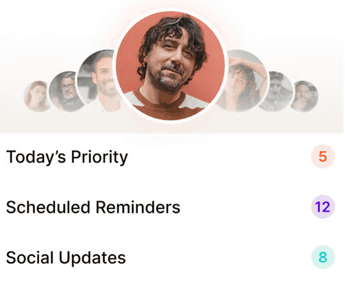
How to use a personal CRM for headhunters: the pre-call / post-call / 30-60-90 loop
Pre-call brief
Two minutes before any client or candidate call, pull up the contact and read the last interaction, the recent LinkedIn activity, and any signals from the past 30 days. Walk in informed.
Post-call voice note
Hold the phone for fifteen seconds and dictate. "Just got off with Priya at NewCo. She's open to a head of growth conversation in Q3. Husband took a job in Singapore so commute considerations matter. Follow up after the founders' offsite, mid-July." The AI extracts the follow-up date, the context, and the names.
30/60/90 follow-up
After every meaningful conversation — interview, placement, declined offer — three touches at 30, 60, and 90 days. Light, no ask. The point is to be present when the ask comes from their side.
Top personal CRMs for headhunters
How the relationship-layer tools stack up for an executive search workflow:
Tool | Voice capture | Social listening | Vertical fit for recruiters | Best for |
Voice notes with AI extraction | Hiring posts, promotions, job changes, M&A | Built for the candidate-becomes-client cycle | Best fit for headhunters | |
Dex | Typed notes | Job change notifications | Horizontal — no recruiter playbook | MBA students, founders, creators |
Clay | No native voice | Outbound enrichment data | Built for cold prospecting, not warm relationships | Sales teams |
Bullhorn / ATS-only | No | No | Built for active searches, not the in-between | Live placement workflow |
Folk | Web/mobile | Light | General-purpose CRM | Small teams, founders |
LinkedIn alone | No | Manual scrolling | Free but passive | Casual checking, not a system |
What to look for in a recruiter CRM
Mobile-first. You take calls between meetings. Your CRM has to come with you.
Voice capture. Typed notes don't get typed.
Real-time social listening across LinkedIn. Promotions, job changes, hiring posts surfaced as they happen.
A daily reach-out list. Five to eight people with a reason for each.
WhatsApp from your personal number. Anything else trains people to ignore you.


Why we built Regards
I’m bad at staying in touch. Not because I don’t value people. Its a lot of work, and I didn’t have a system. This started as my fix. A quiet assistant that helped me nurture relationships thoughtfully. When people noticed the difference and asked what I was doing, it slowly evolved into a product. And the love has been incredible. Regards, Khuze

Frequently Asked Questions
Will a personal CRM replace my ATS?
No. The ATS handles the live search. The personal CRM handles everything around it — past candidates, dormant clients, your warm network.
My team uses LinkedIn Recruiter. Do I need a recruiter CRM too?
LinkedIn Recruiter is for sourcing inside an active search. A personal CRM for headhunters is for the relationships that produce the next ten searches.
How does the social listening work without being creepy?
It surfaces public activity — posts, job changes, company news — already on LinkedIn. The same things you'd see scrolling at 11pm, just organized for you.
What about data security on candidate information?
Run the same vendor diligence you'd run on any tool touching candidate data. Ask about encryption, retention, and access controls.