
If networking is part of how you build your career or business, you already know the hard part isn’t meeting people. It’s keeping them. Every new event, conference, and introduction adds contacts. And every quiet week, a few more of them drift out of your reach.
A personal CRM built for networking fixes that. It’s the tool that turns the contacts you’ve already earned into a warm, productive network — without requiring you to become a full-time networker.
Key takeaways
|
Why serious networkers use a personal CRM
The people who are best at networking don’t rely on memory. They rely on systems. That’s the unifying insight across every major networking thinker — Ferrazzi, Misner, Burkus, Carnegie. Networking at scale means offloading the “who, when, what about” to a tool, so your brain is free for the actual conversation.
“Networking is more about farming than it is about hunting. It’s about cultivating relationships.” — Ivan Misner, Founder of BNI |
Cultivation needs a record. You can’t remember what everyone’s working on, when you last spoke, what you promised, or who in your network should meet each other. A personal CRM for networking holds all of it, quietly.
What a networking-focused personal CRM actually does
Not every personal CRM is a good networking CRM. Some are glorified contact lists. The ones built for networking do four specific things.
1. Captures new contacts without friction
Business card scans, voice notes after events, LinkedIn imports. The moment you meet someone, their details are in the system with enough context that the follow-up is easy. If capturing a contact takes more than 20 seconds, you won’t do it during a busy conference.
2. Holds context that makes outreach personal
Every contact should have a few lines: how you met, what they’re working on, one personal detail, any promise you made. The next message you send references something real instead of “just checking in.”
3. Owns the cadence so you don’t have to
Tag people into tiers. Set a cadence per tier. The app reminds you when someone is overdue. You stop carrying “I really should email Sarah” in the back of your head.
4. Surfaces signals that make outreach land
A good networking CRM watches your contacts’ LinkedIn activity, job changes, company announcements, and birthdays — and turns them into a list of natural reasons to reach out. “Just saw you’re at a new company — congrats” is easier to send than a cold “hello.”
The math of networking with a personal CRM
People underestimate how much a tool changes the volume of high-quality touchpoints you can maintain. The difference isn’t 10%. It’s often five to ten times.
150 meaningful touchpoints a year from a consistent 30-minute weekly block. That’s three people a week, 48 weeks a year, without trying to remember anyone. Source: Regards, compiled from networking expert frameworks |
82% of small businesses say referrals are their primary source of new business. Source: DemandSage, 2026 |
50% shorter sales cycles when a deal starts with a warm introduction. Source: Harvard Business Review / Influitive |
If most of your pipeline is referrals and warm intros, the tool that makes warm intros happen more often is the tool that prints revenue. That’s why serious networkers — agency owners, freelancers, recruiters, founders, real estate agents — adopt one and stop improvising.
The hidden gold: weak ties and dormant contacts
Here’s a counterintuitive finding that changes how you think about your contact list.
“Our weak ties often build a bridge from one cluster to another and thus give us access to new information. Even though the strong ties in our life are more likely to be motivated to help us, our weak ties’ access to new sources of information may be more valuable.” — David Burkus, Friend of a Friend |
Sociologist Mark Granovetter’s 1973 study, The Strength of Weak Ties, showed that most new opportunities — jobs, contracts, partnerships, referrals — come not from our closest contacts, but from the edges of our network. Our close friends know the same people we do. Our weak ties know everyone else.
28% of new job opportunities come from weak ties vs. strong ties, according to Granovetter’s foundational research. Source: Mark Granovetter, The Strength of Weak Ties, 1973 |
Then there are dormant ties — people who were once close but have faded. The trust is already there. Reactivating them is far faster than building from scratch. A personal CRM for networking is designed to surface both — the weak ties you forget you have, and the dormant ones you mean to reach out to.
A story: the dinner that changed two lives
In 1991, Meg Greenfield, editor of the Washington Post editorial page, arranged a dinner with her friend Katharine Graham. Among the guests were Warren Buffett and Bill Gates. Neither man wanted to go. Buffett assumed Gates was “just a computer nerd.” Gates assumed Buffett was some boring Wall Street broker.
They talked for hours. What followed was one of the most well-documented long-term friendships in business history — a friendship both men have credited with shaping their thinking on philanthropy, investing, and leadership.
The dinner happened because Katharine Graham actively nurtured her network and made introductions between people who should know each other. A personal CRM for networking makes you capable of being the person in the room who does that — at scale, over years.
“The person most likely to change your professional life isn’t your best friend. It’s someone you used to know.” — David Burkus |
Who gets the most out of a networking CRM
A networking CRM is most valuable for people whose opportunities come through relationships, referrals, and long-term trust.
If your business depends on staying top of mind consistently, this is where a personal CRM creates leverage over time.
Consultants and freelancers
Your next project is usually one warm introduction away from someone you already know. A personal CRM keeps that network warm in the background so you spend less time prospecting.
Agency owners and founders
Investors, partners, design partners, alumni clients, prospects — you’re maintaining a dense web. A personal CRM keeps every layer alive without another hire.
Executive recruiters and agents
Your ATS tracks mandates. Your personal CRM tracks the slow, important relationship layer — the one that creates the next mandate.
Real estate agents and brokers
90% of your business is repeat and referral. A personal CRM is the difference between a thriving book and a fading one.
Conference and event professionals
You meet dozens of people a month. Without a system, 80% fade inside a quarter. With one, you keep every good connection in motion.
Sales professionals with personal pipelines
Your company CRM tracks deals. A personal CRM tracks the broader relationships — champions, former clients, partners — that feed those deals in year three, five, ten.
The weekly rhythm of a serious networker
Here’s what using a personal CRM for networking actually looks like on a Wednesday morning.
The 30-minute weekly networking block Open your personal CRM. Look at who’s overdue based on your cadence. Send 3–5 short messages — a check-in, an article, a congrats, a re-engagement. Follow up on any promise from last week: intros, articles, answers. Add any new contacts from the week. Log one personal and one professional detail. Make one introduction between two people in your network who should know each other. |
Over a year, that single block produces more relationship value than most people accumulate in a decade of improvised networking. The magic is consistency, not intensity.
The give-first rule (seriously)
The tool only works if the ratio is right. Roughly 80% of your outreach should be giving — an article, a congrats, an introduction, a thoughtful comment. 20% can be about you. Flip it, and people avoid your messages. Keep it, and people genuinely welcome them.
“Real networking is about finding ways to make other people more successful.” — Keith Ferrazzi, Never Eat Alone |
Adam Grant’s research across 30,000 professionals found that the most successful people in nearly every field are consistent givers — the strategic kind, not the naive kind. Takers dominate the short term. Givers dominate the long term. A personal CRM makes giving systematic: you notice when to congratulate, when to share, when to connect.
Features that separate networking CRMs from contact managers
If you’re evaluating tools, here’s what actually matters in the networking context.
Mobile-first capture: business card scanning, voice notes, quick-add from your phone during events
Cadence and tiering: the ability to assign different follow-up rhythms to different relationships
Signal surfacing: job changes, posts, launches, anniversaries — so outreach has a reason
Interaction history: scan in 5 seconds before a call to remember what you last spoke about
Weekly lists: a prioritised view of who to reach out to, prepared for you
Conversation starters: AI-assisted suggestions based on recent context and activity
Anything that doesn’t help you do one of these six things is probably noise. The best networking CRMs keep the core tight and mobile.
Why networking CRMs beat spreadsheets and contact apps
Spreadsheets work for a month. They break down past a few hundred contacts. They don’t remind you. They don’t surface signals. They don’t hold interaction history well.
A phone’s contact app is worse — it’s a phonebook, not a relationship tool. No notes. No cadence. No reminders. No context before a call. You end up maintaining relationships from willpower alone, which means you don’t maintain them.
A personal CRM for networking removes the three things that break every DIY system: you forget who’s overdue, you lose the context, and you miss the signals. Hand those three to software. Keep the humanity for yourself.

Common objections (and why they don’t hold up)
Most people resist relationship management tools for reasons that sound reasonable at first — until you look closer at how relationships actually fade over time.
These are the most common objections, and why they usually break down in practice.
“It feels transactional.”
It is the opposite of transactional. A relationship you never return to is what feels transactional. Using a tool to make sure you remember, check in, and reciprocate is the most caring thing you can do with a big network.
“I’ll remember the important people.”
You won’t. Nobody does. Your memory is a narrow rail. A personal CRM is the branch line that keeps the rest of your network from silently unraveling.
“I don’t have time.”
30 minutes a week. The same time you spend scrolling LinkedIn during lunch. If relationships drive your revenue or career, this is the single best ROI you can get from half an hour.
“I already have LinkedIn.”
LinkedIn is a directory, not a relationship tool. It tells you who people are. A personal CRM tells you when to reach out, what to say, and what you promised last time.
How Regards works for networkers
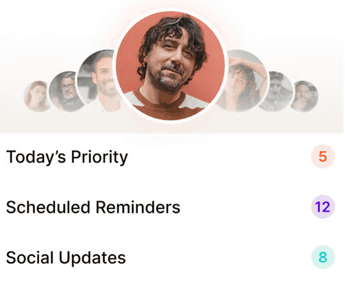
Regards is a mobile-first personal CRM built specifically for people whose work depends on networking. Scan a card at an event, leave a voice note after a coffee, and the AI turns it into a contact with notes, follow-ups, and a cadence. Each week, Regards gives you a prioritised list of 5–8 people to reach out to, with context from past conversations and suggested conversation starters based on their latest activity. You focus on the humans; Regards runs the admin. See it in action at regardsapp.ai

Why we built Regards
I’m bad at staying in touch. Not because I don’t value people. Its a lot of work, and I didn’t have a system. This started as my fix. A quiet assistant that helped me nurture relationships thoughtfully. When people noticed the difference and asked what I was doing, it slowly evolved into a product. And the love has been incredible. Regards, Khuze

Frequently Asked Questions
What is a personal CRM for networking?
A personal CRM for networking is a tool built to help an individual professional manage, maintain, and grow their network. It captures new contacts, logs conversations, tracks follow-up cadence, and surfaces signals that make outreach feel natural — all in one place.
How is it different from a sales CRM?
A sales CRM tracks deals. A personal CRM for networking tracks relationships. Different user, different unit of work, different cadence. Many people use both — a sales CRM for active deals, a personal CRM for the long-term relationship layer that feeds the pipeline.
Do I need a personal CRM if I already use LinkedIn?
LinkedIn is a public directory. It doesn’t give you cadence reminders, hold your private notes, or surface weekly lists of who’s overdue. A personal CRM sits on top of LinkedIn, Gmail, and your phone contacts — turning them from a static list into an active relationship system.
What are the best features to look for in a networking CRM?
Mobile-first capture (card scanning, voice notes), cadence and tiering, signal surfacing (job changes, posts), quick interaction history before a call, a weekly prioritised list of who to reach out to, and AI-assisted conversation starters. Keep it simple — features beyond these six tend to be noise.
How much time does it take to use a personal CRM for networking?
Thirty minutes a week is the standard. A weekly block to act on the reminders, log new contacts, and send a handful of thoughtful messages. Plus 30 seconds here and there to capture a new contact or drop a note after a conversation. That’s the whole commitment.