

Client retention in wealth management does not come from performance alone. In years where markets perform well, clients stay with everyone. In challenging years, the advisors who keep clients are not necessarily the ones with the best numbers — they are the ones whose clients feel cared about, remembered, and genuinely known. That is a relationship problem, and a personal CRM is how you solve it systematically.
Key Takeaways
|
The Relationship Gap Most Advisors Have
Most advisors are excellent at the transactional moments — the review meeting, the market volatility call, the portfolio rebalancing. Where the relationship gap appears is in the space between these events: the 11 months of the year when the advisor is focused on delivery and the client can quietly wonder whether they are just an account number.
Personal details — a client's grandchildren, a business milestone they mentioned, a concern about a family member — are remembered in the first meeting and forgotten by the third year. A personal CRM stores this context and surfaces it at the right moment, making every interaction feel like you have been paying attention all along.
How a Personal CRM Works for a Wealth Manager
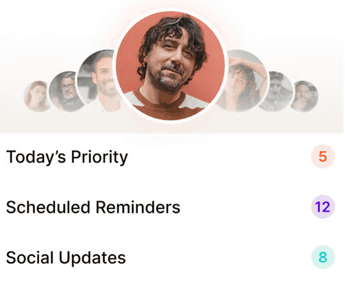
Each client gets a contact record with their financial context, their personal details, their communication preferences, and a touchpoint cadence based on relationship tier. Top clients: monthly contact through a mix of calls, notes, and in-person meetings. Secondary clients: quarterly. Strategic referral sources: monthly to bimonthly.
When a touchpoint comes due, the CRM surfaces it with relevant context: recent LinkedIn activity, a milestone you noted, something from your last conversation. You reach out with something specific rather than a generic check-in — and the client experiences you as someone who genuinely pays attention.
The referral conversation happens naturally in this context. When a client is consistently experiencing high-quality, personalised attention, the ask for introductions feels like a natural extension of the relationship rather than an imposition.
Building a Referral Engine in Your Practice
Identify your top 15–20 clients who have the largest networks that overlap with your ideal client profile. These are your primary referral candidates. Set a deliberate touchpoint cadence for each — not just the standard review schedule, but additional informal contacts throughout the year.
After each value-delivery moment — a strong review, a tax planning win, a problem resolved — use the VIPS referral framework to naturalise the ask. Check they are seeing value, frame with purpose, get permission to brainstorm, and ask specifically about who in their network might benefit.
Track every referral in your CRM: who referred whom, when, and what came of it. This data tells you which client relationships are generating practice growth, and helps you invest proportionally more attention in the relationships that matter most to your business.

Why we built Regards
I’m bad at staying in touch. Not because I don’t value people. Its a lot of work, and I didn’t have a system. This started as my fix. A quiet assistant that helped me nurture relationships thoughtfully. When people noticed the difference and asked what I was doing, it slowly evolved into a product. And the love has been incredible. Regards, Khuze

Frequently Asked Questions
Is using a personal CRM compliant with wealth management regulations?
A personal CRM tracks relationship context and outreach timing — it does not hold client financial data or make recommendations. It sits outside regulated workflows. Confirm with your compliance team for your specific jurisdiction and firm requirements.
How is this different from the client management system my firm provides?
Firm-provided systems track portfolios, compliance, and transactions. A personal CRM tracks the relationship layer — personal context, conversation history, touchpoint cadence. They are complementary tools serving different purposes.
How do I make client outreach feel personal when I have 100+ clients?
Context is the differentiator. A CRM that carries forward personal details — family, hobbies, professional milestones, things they mentioned — lets you personalise at scale. The message needs to feel specific to them, even if a system prompted you to send it.
What is the best way to ask a wealth management client for a referral?
After a strong review meeting or a specific value moment. Use specific language: not 'do you know anyone?' but 'do you know any business owners in your industry who are at a stage where they are starting to think seriously about their long-term financial plan?' Specificity triggers relevant names.