
If you rely on relationships and referrals for your income, you've probably heard of both Regards and Dex. They're the two most talked-about personal CRMs for professionals who live off their warm network realtors, headhunters, consultants, and small business owners who know that their next deal is almost always a conversation away.
But they are not the same product. They make different bets on what you actually need, and choosing the wrong one means leaving the features you care about on the table.
This is a no-fluff, head-to-head breakdown of both tools in 2026 what each does well, where each falls short, and who each is built for.
Key Takeaways
|
What Is Dex?
Dex (getdex.com) is a personal CRM that's been around since 2019. It's built one place to track all your contacts, set follow-up reminders, and log every interaction. Its killer feature is a Chrome browser extension that works inside LinkedIn, Gmail, Twitter, and Instagram, letting you add contacts from those sources without ever leaving the page you're on.
Dex also has a 'Text Dex' feature you can log a quick note about a meeting by just texting from your regular phone. It syncs across web, iOS, and Android and sends pre-meeting briefings before your calendar calls.
Pricing: Dex runs $12–20/month depending on your plan.
What Is Regards?
Regards (regardsapp.ai) is a newer entrant, built mobile-first for professionals whose best business comes from their existing network. The core idea is simple: 70% of small business revenue comes from people you already know. Regards helps you reach them consistently without it feeling like work.
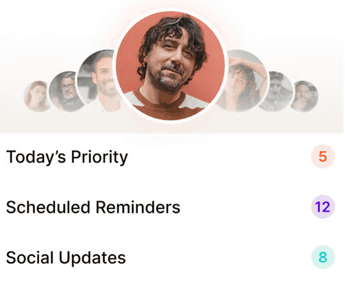
Its standout features are voice notes with AI extraction you record a quick voice note after a meeting and Regards automatically pulls out follow-up tasks, reminders, and contact details and a daily AI priority list that tells you exactly who to reach out to today. It also includes a digital briefcase for sharing intro materials on the spot, and AI-generated conversation starters so you always know what to say.
Pricing: Regards starts at $12/month for the Basic plan and $20/month for Pro.
Feature-by-Feature Comparison
Feature | Regards | Dex |
Mobile app (iOS) | ✅ Yes | ✅ Yes |
Mobile app (Android) | ✅ Yes | ✅ Yes |
App Rating | 5 ★★★★★ | 4.2 ★★★★★ |
Browser / LinkedIn extension | ❌ Not available | ✅ Chrome extension — works inside LinkedIn, Gmail, Twitter |
Voice notes with AI extraction | ✅ Record a note, AI builds contact profile + reminders automatically | ❌ Text-only notes that are not searchable |
Daily AI priority list | ✅ Proactive list of people to reach out to + reminders based on cadence | ❌ Only reminds you if you have set a reminder |
Digital briefcase | ✅ One-click sharing of intro materials at the moment of meeting | ❌ No equivalent feature |
Pre-meeting briefings | ⚠️ Via interaction history (in development) | ✅ Email briefing before every calendar call |
AI conversation starters | ✅ Tells you what to say for each contact | ❌ Not available |
Text/SMS note logging | ❌ Not available | ✅ Text Dex from any phone |
Built for | Referral & relationship-oriented professionals | Students, investors, general professionals |
Starting price | $12/month | $12/month |

Where Dex Has the Edge
Dex's Chrome extension is genuinely great — if you spend serious time on LinkedIn, it lets you add contacts, log notes, and see relationship history without changing your workflow at all. The Text Dex feature is similarly frictionless for busy people who don't want to open an app. It has fewer AI features but the base product works well — it's been building for 6 years.
Where Regards Has the Edge
Voice-first capture is a genuine moat. If you're a realtor leaving a showing, a recruiter finishing a call, or a consultant walking out of a client meeting — Regards lets you speak your follow-up out loud. Dex requires you to type everything, which is fine at a desk but frustrating on the go.
The daily priority list changes the game. Most CRMs are passive databases — they store information but don't tell you what to do with it. Regards actively tells you who to contact today, ranked by urgency and relationship cadence. If you need an action prompt, not just a data store, this matters.
The briefcase feature is unique. Meeting someone at a conference and being able to instantly share your intro deck, bio, and contact card in one tap has no equivalent in Dex. For real estate agents and consultants, this is a natural part of the workflow that Regards built for directly.
Regards was designed specifically for referral-dependent professionals. Every feature maps back to the same goal: help you stay top of mind with your warm network so they send you business. Dex is a great general tool; Regards is a specialized one.
Who Should Use Dex
Professionals who spend significant time on LinkedIn and want in-browser contact management
People who prefer typing over speaking and want a mature, stable product
Users who want a strong web app experience alongside mobile
Those whose primary network is online rather than in-person
Those who prefer passive structured data and don't need active networking nudges
Who Should Use Regards
Small business owners, headhunters, realtors, and consultants whose best business comes from referrals and in-person relationships
Professionals who network on the move and need frictionless voice-based note capture
Anyone who wants to be told proactively when and how to reach out as a daily habit
Those who want AI-native features that save personal details and extract follow-ups automatically — a real assistant for your network
The Bottom Line
Both tools are solid. But they solve for different users. Dex wins on LinkedIn integration and product maturity. Regards wins on mobile-first design, voice-based capture, and active daily coaching for referral-focused professionals.
If your workflow is mostly digital and LinkedIn-centric, try Dex first. If you close deals face to face and need a system that works as fast as your conversations, Regards is worth your attention

Why we built Regards
I’m bad at staying in touch. Not because I don’t value people. Its a lot of work, and I didn’t have a system. This started as my fix. A quiet assistant that helped me nurture relationships thoughtfully. When people noticed the difference and asked what I was doing, it slowly evolved into a product. And the love has been incredible. Regards, Khuze

Frequently Asked Questions
What is the difference between Regards and Dex?
Regards is a mobile-first, AI-native networking assistant with voice note extraction, a daily AI priority list, and AI conversation starters is designed for referral-driven professionals who network in person. Dex is a more established personal CRM built around LinkedIn integration, a Chrome browser extension, and cross-platform contact sync — best for professionals whose networking is primarily digital.
Does Dex have AI features?
Dex has some AI-assisted features, including pre-meeting briefings and basic message drafting. However, it lacks the core AI-native features that Regards offers: voice note extraction, a proactive daily priority list that tells you who to contact, and AI conversation starters for every contact.
Which personal CRM is better for realtors: Regards or Dex?
Regards is the better choice for most realtors. Its voice note capture works perfectly at showings and open houses, the daily AI priority list drives consistent outreach, and the digital briefcase enables instant in-person sharing. Dex is better suited to agents who do most of their networking on LinkedIn rather than face to face.
What is the daily priority list feature in Regards?
Every day, Regards generates a ranked list of the contacts you should reach out to that day, based on your relationship cadence, interaction history, and relationship urgency. It then provides AI-generated conversation starters for each person so you always know what to say. The result is a 5-minute morning habit that keeps 200+ relationships consistently warm.
Is Regards or Dex better for in-person networking?
Regards is significantly better for in-person networking. It was built specifically for professionals who meet people at events, open houses, conferences, and client meetings. Voice note capture means you can log a contact immediately after meeting them. The digital briefcase means you can share your intro materials in one tap. Dex is designed primarily for digital, online networking workflows.