Monday morning, 7:14am. You're at the BNI meeting. You've shaken twelve hands, sat through ten 60-second commercials, exchanged contact info with two new visitors, and committed to a 1-1 with someone you've been meaning to meet for a month.
By Friday, half of what got said will have evaporated. The visitor's company name. The follow-up you owed your 1-1 partner. The referral you promised to make for the mortgage broker. None of it is in BNI Connect, because BNI Connect was built for the chapter mechanics, not for the actual work of being in a chapter.
This isn't a knock on BNI Connect. It's a working tool for what it's designed to do. But the moment you walk out of the room, you need a different BNI app for a different job.
Key takeaways• BNI Connect handles chapter operations. Serious networkers need a personal BNI app for follow-ups and 1-1 management. • The actual revenue from networking groups is created in the week between meetings, not the meeting itself. • Voice-first capture turns the parking-lot debrief into searchable context. • The Monday-morning ritual: ten minutes after the meeting, log every conversation. That's the system. |
Why BNI members need a personal networking group app
BNI is built on a simple insight: showing up consistently with the same group of small business owners compounds into real revenue. The chapter machinery — attendance, visitor tracking, the structure of the meeting — exists to enforce consistency.
What the chapter machinery doesn't enforce is your personal follow-through. The 1-1 you promised. The referral you owed. The visitor you said you'd reach out to. That's the work a personal networking group app is for.
Why BNI Connect alone isn't enough
BNI Connect handles chapter administration. It tracks attendance, visitor data, referrals given and received, and one-to-one logs in summary form. If you're a chapter leader or visitor host, it's useful.
What it doesn't do is the personal work. It doesn't surface "the four chapter members you haven't had a 1-1 with this quarter." It doesn't pull in LinkedIn signals when one of your fellow members gets promoted. It doesn't queue up the follow-up to the visitor who showed real buying intent two weeks ago.
That's a personal layer, and it needs a personal tool.
What an app for serious networkers should actually do
Capture 1-1 meeting notes from your phone
Walk out of the 1-1, sit in your car, hit record. Fifteen seconds of voice note about what you talked about, what you committed to, what they need from their ideal client. The tool extracts the names, the referrals, and the follow-ups.
Auto-extract follow-ups
When you dictate "need to introduce her to two contractors next week," the tool extracts that as a follow-up task with a date. You don't manage it manually. It just shows up on Tuesday morning's list.
Encourage proactive networking habits
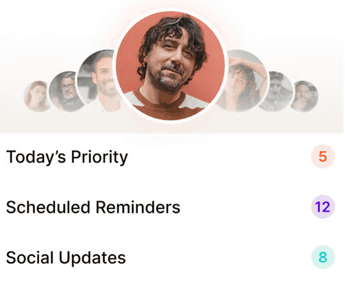
A daily list of five to eight people worth reaching out to today, each with a reason. The point isn't a notification. It's a prompt that turns intent into action. Networking is a behavioural problem before it's a software problem.
Pull in LinkedIn signals from your network
Promotions, job changes, hiring posts, milestones from fellow members and from visitors. Real reasons to reach out instead of manufactured ones.
How to use a networking app: the Monday-morning ritual
Ten minutes after every chapter meeting
Before you start your work day, sit in the car or at the coffee shop and process what just happened. Voice note for each meaningful conversation. Capture the visitor's info. Log the follow-up you committed to.
Voice notes from each 1-1
After every 1-1, a 30-second voice note. Their ideal client. Their three best referrals to give. What you owe them. What they owe you. The next time you talk, that context is there.
Setting next follow-ups
Every conversation ends with a next touch. Sometimes that's tomorrow. Sometimes it's a quarter out. The tool queues it. You don't have to remember.
Top BNI apps and weekly networking apps compared
Tool | Voice + mobile | 1-1 capture | LinkedIn signals | Best for |
Regards | Voice-first, mobile-first | Voice note + AI extraction | Real-time across your network | Best fit for BNI / Rotary members |
BNI Connect | Mobile available | Manual log | No | Chapter administration only |
Dex | Desktop-first | Typed notes | Job-change notifications | MBA students, founders |
Spreadsheet | No | Manual | No | First 30 contacts |
LinkedIn alone | Mobile | No structure | Manual scrolling | Free but passive |
HubSpot Free | Mobile available | Built for sales pipelines | Limited | Sales teams |
What to look for in a weekly networking app
Voice-first capture. The car-and-coffee-shop test is the right test.
Business card scan. Visitors don't always carry cards, but when they do, you shouldn't be retyping.
A daily priority list. Five to eight people worth a reach-out, with a reason for each.
LinkedIn signals. Promotions, job changes, posts from chapter members and visitors.
Reasonable pricing for a solo operator. Under $200/year, free trial that doesn't ask for a card.

Why we built Regards
I’m bad at staying in touch. Not because I don’t value people. Its a lot of work, and I didn’t have a system. This started as my fix. A quiet assistant that helped me nurture relationships thoughtfully. When people noticed the difference and asked what I was doing, it slowly evolved into a product. And the love has been incredible. Regards, Khuze

Frequently Asked Questions
Will my chapter switch to this from BNI Connect?
No. The chapter keeps using BNI Connect for chapter operations. You use a personal BNI app on top, for your work.
Is this only for BNI?
The pattern works for any weekly networking group. Rotary, chambers, industry circles, mastermind groups, alumni networks.
Do I need to log every conversation?
No. Log the ones that mattered. Over time, the tool becomes the institutional memory you wish you had.
What about visitors who don't join the chapter?
Especially log those. The most overlooked revenue in BNI is the visitor who came once, didn't join, and was a perfect client for you.