
Most people who Google "best networking tools" come back with a list of 22 apps and no clarity on which ones they actually need. The list is the wrong shape. Networking is a sequence of jobs, not a category. The right tool for one job is the wrong tool for the next.
This guide picks the best networking tools for each of the six jobs networking actually involves, then puts a real stack together. Written by the Regards team. We make one of the tools on this list, and we'll tell you where another tool wins.
Key takeaways• Networking tools 2026: stop stacking, start sequencing. Six jobs, one tool per job. • The top networking apps that show up across most stacks: LinkedIn (discovery), Fireflies (capture in meetings), Dex (remember), Regards (follow-up, proactive habit, signals). • The best networking software for you depends on where you leak the most contacts — capture, memory, follow-up, or habit. • Skip event-specific apps for long-term work. They die when the event ends. |
Why most people stack the wrong networking tools
Two patterns show up in the wrong stacks. The first is over-stacking — eight apps, each handling 5% of the work, with the seams losing more value than the apps create. The second is under-stacking — a single tool (usually LinkedIn or a spreadsheet) trying to do every job badly.
The right stack matches one tool to each job. The best networking tools are the ones that own a stage of the cycle and integrate cleanly with the rest.
The six jobs the best networking tools have to do
Discover new people worth meeting
Capture every conversation (in meetings, at events, after calls)
Remember the context across years
Follow up on time
Build a proactive habit (decide who to reach out to today)
Surface signals that give you reasons to reach out
Best networking tool for discovery: LinkedIn
LinkedIn is still the best discovery tool in 2026. Search by company, role, industry. Find the second-degree connections to your dream prospects. Read posts from people whose work you respect. No other top networking app holds discovery as cleanly.
LinkedIn's weakness is everything past discovery. The moment you've found someone, LinkedIn stops helping. That's where the next five tools come in.
Best networking tool for capture (in meetings): Fireflies
If a meeting was scheduled, a notetaker like Fireflies captures the audio, transcribes it, and pulls action items. For client meetings, partner calls, and recurring 1:1s, this is the right shape of tool.
Fireflies covers structured calls well. It doesn't cover the unstructured stuff — the coffee chat, the elevator ride, the conversation in the parking lot — where most networking happens.
Best networking tool for remembering context: Dex
For desk-based knowledge workers who live in LinkedIn and email, Dex is the most established memory tool. Deep two-way sync with Gmail, Outlook, Calendar, iMessage, WhatsApp, LinkedIn. A keep-in-touch board that holds the schema together.
Dex earns its place for the user who works at a desk. For the user who works between meetings, the memory job belongs to a mobile-first tool — see the next section.
Best networking tool for follow-up: Regards
Follow-up is where most networking dies. The conversation happens, the note never gets written, the follow-up never gets sent.
Regards is built around this single failure point. Dictate a voice note, the AI extracts the follow-up and the date, the reminder is queued. After every meeting, a 15-second voice note is the entire workflow. The follow-up message uses your starter line, sent from your number, in your voice.
Best networking tool for proactive habit: Regards
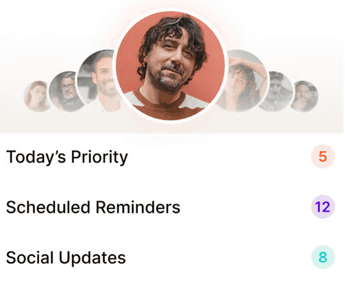
Most networking tools are passive. They wait for you to open them. The proactive habit job — "who should I reach out to today?" — is the rarest capability in the category.
Regards' daily priority engine ranks your entire network and surfaces five to eight names every morning with a reason for each. The decision is made for you. Open the notification, send the message, move on.
This single feature is the biggest behavioural difference between a personal CRM that gets used and one that doesn't.
Best networking tool for surfacing signals: Regards
Reasons to reach out shouldn't be manufactured. They should be triggered by what's actually happening in your network.
Regards listens across LinkedIn for promotions, job changes, hiring posts, fundraising, M&A, milestones, podcast features, and post activity. Each signal becomes a notification with a starter line attached. "Daniel just got promoted to VP — here's a draft to send." Send, done.
LinkedIn shows you some of this in the feed. The volume is too high to scan reliably. The signal surfacing job belongs to a tool that filters for you.
The networking software stack that actually works in 2026
The cleanest stack for most professionals:
Job | Tool |
Discover | |
Capture (in meetings) | Fireflies (or your notetaker of choice) |
Capture (between meetings) | Regards (voice notes + business card scan) |
Remember | Regards (mobile, AI-native) or Dex (desktop-heavy users) |
Follow up | Regards |
Proactive habit | Regards (daily priority engine) |
Surface signals | Regards (real-time social listening) |
Send messages | WhatsApp from your personal number + email |
If you don't sit at a desk, the stack collapses further: LinkedIn for discovery, Regards for everything else, your inbox and WhatsApp for sending.
Best networking tools by use case
Best networking apps for real estate
LinkedIn for discovery, Regards for sphere management and the realtor-in-the-car workflow, your brokerage CRM for live transactions. Two systems, clean handoff.
Best networking apps for recruiters
LinkedIn Recruiter for active searches, your ATS for placements, Regards for the relationships in between (past candidates, dormant clients, hiring triggers). Three systems, three jobs.
Best networking apps for conference attendees
Skip the event-specific app for anything long-term. The capture + follow-up + signal stack (Regards) is what travels with you between conferences.
Best networking apps for solo consultants
LinkedIn for visibility, Regards for the warm network that produces repeat work, your inbox for sending. That's the whole stack for a one-person business.

Why we built Regards
I’m bad at staying in touch. Not because I don’t value people. Its a lot of work, and I didn’t have a system. This started as my fix. A quiet assistant that helped me nurture relationships thoughtfully. When people noticed the difference and asked what I was doing, it slowly evolved into a product. And the love has been incredible. Regards, Khuze

Frequently Asked Questions
Why isn't every CRM on this list?
Most CRMs are built for sales pipelines, not networking. They're the wrong shape for the job. Personal CRMs are.
Can I use just LinkedIn for everything?
Discovery is the only job LinkedIn does well. The rest leak unless you stack at least one capture + memory tool on top.
Are AI networking tools different from regular networking tools?
AI is the difference between a tool that holds your data and a tool that does the thinking — who to talk to, what to say, when to follow up.
What about conference-specific apps?
Useful during the event for the schedule and chat. Not where your contacts should live after the event ends.