

Let’s cut to the chase. Networking for growth isn't about the sheer number of contacts you make; it’s about how frictionless you make the transition from ‘total stranger’ to ‘reliable authority.’ Trying to build that kind of network manually in 2026 is a losing game.
The only real way to win is to leverage technology that does the heavy lifting for you, allowing you to connect more deeply and network more effectively. In this guide, we’re breaking down the top tools that help you bridge that gap without losing your soul to the algorithm.
Key Takeaways:
|
1. CRM Tools for Networking
Clay
Clay automatically crawls LinkedIn updates, news mentions, and social media activity to update you on what your network is doing in real-time. This makes your networking hyper-informed because you get alerts for job changes or press mentions. It’s built for power-users who want the tool to do the heavy lifting of "who is doing what" in the background.
Regards
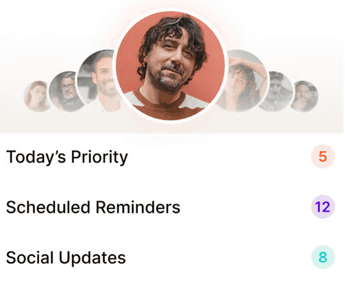
Regards is a mobile-first networking companion built specifically to help you stay top-of-mind with the people who matter. It is designed to be a simple, everyday companion that removes the ‘busywork’ and complexity often associated with traditional systems. In just 5 minutes a day, the tool tells you exactly who to contact and provides natural reasons to reconnect. Because it remembers the specific details for you, your networking remains human and consistent rather than feeling like a chore.
2. Professional Networking Tools
LinkedIn Sales Navigator
LinkedIn Sales Navigator helps you stop shouting at the general feed and lets you focus your networking on the exact people who actually move the needle for your business. By tracking company growth alerts, you can reach out exactly when they are most likely to say yes to a new partnership. It transforms your outreach from a cold ‘spray and pray’ into a series of high-signal conversations with relevant people.
Contra
On Contra, you showcase actual projects and deliverables, which allows you to build a reputation based on proof of work and competence. It connects you with other high-level collaborators who need to see what you are capable of offering. It’s how you find high-trust partners who value your offerings enough to stick around for years instead of just one-off projects.
3. Events and Meetup Platforms for Business Networking
Luma
With Luma, you can find those invite-only ‘founder dinners’ or specific industry workshops that aren't advertised on the big, generic sites. By seeing the attendee list beforehand, you can strategically prep your talking points for specific individuals. This moves your networking from ‘randomly bumping into people’ to ‘executing a plan.’
Bizzabo
When you’re attending the major global summits, Bizzabo uses matchmaking features within its app to suggest meetings between you and other attendees based on shared interests. You can use this tool to schedule 1-on-1 meetings in quiet networking lounges. It ensures your time is spent in deep, one-on-one conversations at large-scale business events.
4. Referral and Community Platforms
Common Room
Common Room listens to what people are saying about your brand or niche across Slack, Discord, and LinkedIn. It identifies those who already advocate for you and are high-intent prospects, asking the right questions but haven't yet entered your sales funnel. By tapping into these signals, you have a chance to network with ready-to-buy partners who close twice as fast as any cold lead.
ReferralRock
ReferralRock turns the referral process into a professional, automated system. It gives your partners a structured way to refer to you and tracks the rewards for them. This keeps you top-of-mind for your existing network. When they know there is a frictionless system in place, they are much more likely to do the talking for you.
5. Networking-Based Tools and Apps
Lunchclub
Lunchclub uses an algorithm to pair you for 1-on-1 video chats with people based on your specific goals. Since both attendees are there specifically to network, the ‘small talk’ phase is cut short, and you get straight to the value. It introduces you to a high-value circle of peers you would never find through standard social searching.
Blinq
Most networking fails in the gap between the card exchange and the follow-up. Blinq is a digital business card that resolves this by turning every scan into a contact exchange. When someone scans your code, they get a nudge to send their info right back to you. It puts an end to that "I'll find you on LinkedIn later" brush-off that usually kills most networking. Their details land in your CRM right then and there.
Final Takeaway: Start Using These Tools to Grow Your Business
Networking is not about how widely your business cards are distributed; it's about whether you can stay top-of-mind by being genuinely helpful and consistently relevant. To truly grow your business, you need to use the right tools to bridge the gap between being known and being trusted and remembered.

Why we built Regards
I’m bad at staying in touch. Not because I don’t value people. Its a lot of work, and I didn’t have a system. This started as my fix. A quiet assistant that helped me nurture relationships thoughtfully. When people noticed the difference and asked what I was doing, it slowly evolved into a product. And the love has been incredible. Regards, Khuze

Frequently Asked Questions
1. What are the tips for successful business networking?
Check in on your connections consistently and be genuinely curious about how they are doing. High-growth networking focuses on offering value without ever expecting a sale in return. The trick is to let technology handle the heavy lifting of ‘remembering’ so you can focus on the actual ‘connecting.’ When you combine digital organization with human finesse, you start being a trusted partner for your network.
2. How to use social media to grow for effective networking?
Use social media as a discovery engine to find like-minded professionals in your specific niche. Instead of just broadcasting your own content, spend 80% of your time engaging with the posts of your network. Join private communities and relevant social media groups to build rapport in a low-pressure environment before you ever move to a direct message.
3. Which social platform is best for professional growth?
LinkedIn remains the gold standard for professional growth. It allows you to network with decision-makers directly. However, the secret is not just having a profile; it's using the platform to share insights that solve problems, which naturally draws your target network to you.
4. How to use business cards for effective networking?
When you are at a networking event, your business card shouldn't just be a piece of paper you hand out; it should be a tool for data exchange. Make use of digital card scanner apps to get this done for you and target high-value business owners and focus on quality over quantity. Instead of just giving your card, ensure you capture their contact information instantly, so the follow-up is already in your system before the event ends.