

Most people who’ve worked in a modern office have used a CRM. They’ve also, at some point, closed it in frustration.
The problem isn’t that CRMs are bad. It’s that they were designed for one very specific job — helping a sales team manage a pipeline of deals — and we’ve been trying to use them for a much harder job, which is nurturing long-term professional relationships.
A relationship management system (RMS) is what happens when someone finally builds software for that second job. This post walks through what an RMS actually is, how it’s different from a CRM, and why this category exists in the first place.
Key takeaways
|
The short answer
A relationship management system (RMS) is a tool designed to help an individual or a small team maintain and grow a portfolio of long-term relationships — clients, candidates, partners, referrers, mentors, investors, or friends — as an ongoing, evolving network, rather than a series of short-term transactions.
Where a CRM asks: “where is this deal in the pipeline?”, an RMS asks: “who in my network have I not spoken to recently, and what’s a real reason to reach out?”
“It’s better to be the best connected than the most connected.” — Reid Hoffman, co-founder of LinkedIn |
Why we needed a new category
The CRM category was born in the late 1990s around one core problem: sales pipelines were getting messy, and teams needed shared, structured data to manage them. Salesforce, HubSpot, Pipedrive — they all orbit the same gravitational centre. The deal. The pipeline. The close.
The trouble is, almost none of the most valuable business activity actually happens inside a pipeline. It happens in the long, slow, warm layer above it: the referrals, the reputations, the relationships you’ve tended for five years that suddenly matter when a decision needs making.
82% of small businesses say referrals are their primary source of new business. Source: DemandSage, 2026 |
65% of revenue for small businesses comes from referral business. Source: Nielsen Global Trust Index |
If 65–82% of real revenue comes from the relationship layer, it’s a little strange that almost all our software was built to manage the 18–35% that doesn’t. An RMS tries to fix that imbalance.
The clearest way to understand the difference
The easiest way to see where a CRM ends and a relationship management system begins is with an example.
How a CRM thinks
You log in. You see a pipeline. Leads flow from “contacted” to “demo booked” to “proposal sent” to “closed.” You get reminders when a deal is stalling. A report tells you your close rate and your average deal size. Your boss looks at the forecast.
This is great. If you’re running a sales team.
How an RMS thinks
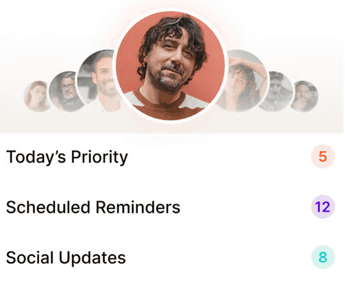
You open the app. You see five to eight people the system suggests you reach out to this week — based on how long it’s been, who’s posted something notable, who’s about to hit a work anniversary, and who’s in a stage where a warm touch could matter. Each one comes with context: your last conversation, what they’re working on, what they mentioned last time, and a suggested way in.
You send a few messages. You scan a business card from yesterday’s event. You leave a voice note after a call, and the AI extracts the follow-ups. You close the app. That’s the whole thing. Total time: under 30 minutes a week.
“Networking is more about farming than it is about hunting. It’s about cultivating relationships.” — Ivan Misner, Founder of BNI |
CRM vs. RMS: what’s actually different
A CRM manages deals moving through a pipeline. An RMS manages relationships that compound over years.
They may look similar on the surface, but they are built for completely different ways of working.
Unit of work
CRM: A deal / opportunity moving through stages
RMS: A relationship, maintained over years
Who it’s built for
CRM: Sales teams with shared pipelines
RMS: Individuals and small teams whose revenue depends on long-term relationships — consultants, agencies, headhunters, advisors, real estate agents, founders
Where you use it
CRM: Desktop-heavy, often a workstation tool
RMS: Mobile-first, used in taxis, between meetings, at conferences
What success looks like
CRM: Pipeline coverage, close rate, revenue forecast
RMS: Cadence health, network depth, warm referrals generated
How data enters the system
CRM: Mostly manual data entry by reps (which is why so much of it is empty)
RMS: AI-assisted capture — business card scans, voice notes, public data enrichment
What the AI does
CRM: Lead scoring, forecast modelling, next-best-action within a pipeline
RMS: Surfaces signals (job changes, posts, anniversaries), suggests outreach, prioritises your week, extracts follow-ups from notes
What the messages look like
CRM: Often bulk sequences from a marketing tool
RMS: Personal, one-to-one, from your own account — AI does the research; the message is yours
The three things an RMS has to do well
If you evaluate five relationship management tools, you’ll notice they all claim a hundred features. The three that actually matter are narrower than that.
1. Capture without friction
If it takes more than 60 seconds to log a meaningful new contact or interaction, you won’t do it. That’s the whole ballgame. The best relationship management systems let you scan a business card, speak a note, and have the AI turn that into a clean contact record with follow-ups already queued.
“Follow up or fail. When you meet someone you want to know better, take the extra step to ensure you won’t be lost in their mental attic.” — Keith Ferrazzi, Never Eat Alone |
2. Prioritise who to reach out to
The core question in nurturing a network isn’t “what do I say?” It’s “who should I reach out to right now?” An RMS answers that every week. A good one hands you a list of 5–8 people with clear reasons: you haven’t spoken in two months, they just posted about a launch, their company just raised a round, it’s their birthday, the last time you spoke they mentioned something that’s now news.
3. Make the message feel like you
The backlash against AI-generated messages is already in full swing. Everyone can tell when they’re receiving one. An RMS that does the research and context-gathering, but leaves the actual message to you — preferably sent from your own WhatsApp, email, or LinkedIn — is the one that will still feel trustworthy in 2026 and beyond.
Who actually needs a relationship management system?
Not everyone. A sales rep working a quota inside a fast-moving pipeline probably still needs a CRM. But a lot of people are stuck trying to force a CRM to do a job it was never built for.
Consultants and freelancers
Your pipeline is your network, not a spreadsheet. An RMS is how you keep the warm referrals that actually pay your mortgage coming in.
Agency partners and small business owners
New business in services is almost always a past client, a past partner, a past introduction. A relationship management system keeps that layer alive.
Executive search and recruiting
The ATS handles mandates. An RMS handles the two decades of candidate and client relationships that generate the next mandate. See our separate guide for how this works in practice.
Founders
Early investors, design partners, first hires, future hires, later-stage investors — these are relationships, not transactions. A relationship management system lets you nurture all of them without turning into a spreadsheet gremlin.
Real estate agents
Repeat business and referrals are effectively the entire business. An RMS keeps your past clients and your local community warm long after closing.
Professionals rebuilding their network
Job-hunters, career-changers, people moving cities. If you’re trying to reactivate a network, a relationship management tool is often the highest-leverage thing you can install.
“Networking is not a spectator sport. It starts with being interested — not interesting.” — Ivan Misner |

The role of AI in a modern RMS
Here’s the honest version: AI is the reason this category is now viable for individuals.
Ten years ago, nurturing 500 relationships was possible only if you were a full-time networker with an assistant. Today, AI handles the parts of that work that used to eat an entire afternoon: enriching contacts, summarising calls, extracting follow-ups, monitoring LinkedIn for signals, prioritising who to reach out to.
What it shouldn’t do is write the actual message, and nothing in this space will convince us otherwise for a while. The moment your network senses that your outreach isn’t you — that it’s a template wearing your face — the whole point is lost.
The right division of labour AI does: research, transcription, enrichment, prioritisation, reminders, signal detection, summarisation. You do: the actual messages, the actual calls, the actual judgement calls about what a given relationship needs. |
How Regards App is different from a CRM
Regards is purpose-built as a relationship management system for professionals whose work depends on who they know — not a sales team in a SaaS company, but the consultant, the headhunter, the agency partner, the real estate agent, the founder juggling sixty conversations at once.
It runs on mobile. It captures contacts and voice notes in seconds. It hands you a weekly list of who to reach out to, with real reasons. It surfaces signals from your network and suggests conversation starters based on your contacts’ recent activity. The messages are yours — sent from your own accounts. Learn more at regardsapp.ai

Why we built Regards
I’m bad at staying in touch. Not because I don’t value people. Its a lot of work, and I didn’t have a system. This started as my fix. A quiet assistant that helped me nurture relationships thoughtfully. When people noticed the difference and asked what I was doing, it slowly evolved into a product. And the love has been incredible. Regards, Khuze

Frequently Asked Questions
What is a relationship management system?
A relationship management system (RMS) is software designed to help a person or a small team maintain a portfolio of long-term professional relationships. It tracks contacts, interactions, and cadence — and uses AI to surface who to reach out to, with relevant context, without replacing the human part of the conversation.
What is the difference between CRM and RMS?
A CRM is built around a sales pipeline — deals moving through stages to a close. An RMS is built around relationships — people nurtured over months and years, whether or not there’s an active deal. Different unit of work, different user, different metric of success. Many professionals benefit from using both in parallel.
Who should use a relationship management system?
Anyone whose income depends on long-term relationships and referrals: consultants, freelancers, agency partners, real estate agents, executive recruiters, founders, advisors, and small business owners. Also useful for professionals rebuilding networks, career-changers, and anyone who simply wants to stay in touch better.
How is Regards App different from a CRM?
Regards is a mobile-first relationship management system — not a sales CRM. It’s built for one person managing their own network of 100–1,500 professional relationships. It focuses on capture (cards, voice notes), prioritisation (who to reach out to this week), and context (signals and conversation starters), rather than deal pipelines and forecast dashboards.
Do I still need a CRM if I use an RMS?
If you’re actively running a sales pipeline with a team, yes — keep the CRM for that job, and use an RMS for the relationship layer. If you’re a solo professional, a small firm, or your revenue is mostly referral-driven, an RMS often does everything you actually need without the CRM overhead.
Is AI relationship management safe and trustworthy?
Used for admin — transcription, enrichment, signals, summaries — AI is a massive productivity gain. Used to auto-generate and bulk-send messages, it rapidly costs you trust, because people can now tell. A trustworthy relationship management system lets AI do the research while keeping the messages yours.