
If you've been Googling "personal CRM" in the last six months, you've probably noticed everyone's product is now an AI personal CRM. The AI label is doing a lot of work in the category, and a lot of the work is marketing.
This guide is the plain-English version. What an AI personal CRM actually does today. What's real and what's a stretch. What separates a useful AI relationship manager from a pretty demo. Written by the Regards team — we build one, so we'll be specific about how the category works.
Key takeaways
|
What is an AI personal CRM, in one sentence
An AI personal CRM is a relationship manager that uses AI to capture context from your conversations, surface signals across your network, and tell you who to reach out to today — instead of waiting for you to remember.
The shorter version: it does the thinking a passive CRM expected you to do.
Why AI personal CRMs are a real category now (and not just marketing)
Three shifts made AI personal CRMs viable in a way they weren't even two years ago.
First, voice transcription and extraction got good enough to turn a 15-second voice note into a structured contact update. Second, large language models got good at reading LinkedIn posts, news, and conversation history to generate context-aware messages. Third, the cost of running these models against thousands of contacts a day became reasonable.
Together, they enabled a different shape of product. AI relationship management isn't a feature anymore. It's the architecture.
The six things AI actually does in a personal CRM today
Voice-to-context extraction
You dictate a sentence after a meeting: "Just left coffee with Priya at NewCo. She's open to a head of growth conversation in Q3. Follow up after the offsite, mid-July." The AI extracts the contact, the follow-up date, the role mentioned, and the context, and saves it to Priya's card. You don't type anything.
Surfacing real signals to reach out, with examples
Real-time social listening watches your network for trigger moments. A few examples:
Promotion: "Daniel just got promoted to VP of Engineering."
Job change: "Maya started a new role at SeriesB-Co last week."
Hiring post: "Aisha posted about hiring a head of marketing."
Milestone: "Tom's company announced a Series B."
Each one becomes a reason to reach out, not a vague "it's been a while" message.
The priority engine: who to reach out to today
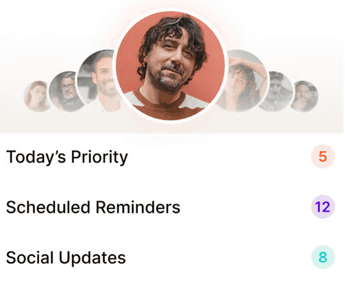
An AI personal CRM ranks your entire network every morning. The output is five to eight names with a reason for each. The ranking is built on signal strength, your cadence tiers, time since last contact, and the contact's tier in your network.
This is the difference between a database and a habit. You don't have to decide who to contact. The decision is made.
Conversation starters
For each name on the daily list, AI drafts a two-sentence opener grounded in the contact's recent activity, your shared history, and the trigger that surfaced them. You edit one phrase and send. The whole thing takes 90 seconds.
The bar for a good starter: specific enough that the recipient knows it wasn't sent to 300 people, short enough that they reply.
AI profile enrichment
Pull a contact in from a business card scan, a LinkedIn import, or a phone contact. The AI fills in the company, role, recent activity, and where you met them — without you typing it.
Good AI profile enrichment is honest about what it knows and doesn't. The bad version invents details that turn out to be wrong on a real call.
Natural-language contextual search
Type or speak: "Who can introduce me to someone at Microsoft?" or "Which past clients moved to fintech?" An AI relationship manager searches across your contacts, notes, and tags using language instead of filters. This is one of the features people don't expect to use until they have it.
What are deal-breaker features in an AI personal CRM
Four things that should stop you from buying:
No voice capture. If the only way to log a meeting is to type, the AI is decorative — the system will go stale within a month.
Generic conversation starters. If the AI suggests "Hope you're doing well!" it isn't reading the signals. Test this in the trial.
No real signal feed. "Job change notifications" alone isn't enough. The good ones surface promotions, hiring posts, fundraising, milestones, and post activity.
No daily priority. If you have to open the app and remember to scan it, the tool will get abandoned by week three.
Top AI personal CRMs in 2026
Tool | Voice + mobile | Signals + daily priority | Best for |
|---|---|---|---|
Regards | Voice-first, mobile-first, AI extraction native | Promotions, jobs, hiring, milestones + 5-8 daily reach-outs | Best fit for revenue-dependent professionals — realtors, recruiters, agencies, consultants |
Dex | Desktop-first; typed notes | Job-change notifications | MBA students, founders, creators at a desk |
Clay | Desktop-first; data-table model | Enrichment for cold prospects | Sales/RevOps running outbound at scale |
Folk | Web + mobile | Lighter than the above | Small teams, founders |
Monica | Mobile available | Light AI | Personal/casual relationships |
Notion + AI | Mobile is light | Manual signal feed | Knowledge workers who like to build their own |
Who needs an AI personal CRM (and who doesn't)
You need one if your revenue depends on relationships — realtors, recruiters, agency owners, consultants, small business owners — and your network is past 100 contacts.
You probably don't need one if your network is under 30 contacts, you're not actively working it, or your role is inside-sales-team pipeline work where a standard CRM already covers the job.

Why we built Regards
I’m bad at staying in touch. Not because I don’t value people. Its a lot of work, and I didn’t have a system. This started as my fix. A quiet assistant that helped me nurture relationships thoughtfully. When people noticed the difference and asked what I was doing, it slowly evolved into a product. And the love has been incredible. Regards, Khuze

Frequently Asked Questions
Is an AI personal CRM the same as a sales CRM with AI features?
No. Sales CRMs track deals through a pipeline. An AI personal CRM tracks relationships across time and surfaces who to reach out to.
Is the AI accurate enough to trust on follow-up dates?
For voice notes that mention dates explicitly ("follow up next Tuesday"), yes. For inferred dates, treat the AI suggestion as a draft you review.
How does an AI relationship manager handle privacy?
Standard SaaS expectations apply — encryption, retention, access controls. Run the same vendor diligence you'd run on any tool touching your contact data.
Will AI write the message for me?
It drafts. You send. The good AI for personal CRM gives you a starting line you'd actually send, not a template you have to rewrite.