
You come home from a conference with business cards, new LinkedIn connections, scribbled Post-it notes, and the best intentions you’ve ever had. Two weeks later, you’ve followed up with maybe four people. That actually puts you ahead of most people.
The reality is that the follow-up is where all the value of a conference actually comes from. That’s what turns into deals in the future that drives the ROI. And yet, most people just don’t bother staying in touch with people they’ve met.
This guide walks you through exactly how to do it, without feeling pushy or spending your entire week writing emails.
Key TakeawaysFollow up post a conference is what drives ROI
Line 1: Reference something specific from your conversation (not “great to meet you”). Line 2: Add one piece of value — a thought, an article, a resource, an intro. Line 3 (optional): Suggest a small, concrete next step, with no pressure. |
Why follow-up is where the real ROI hides
Conferences are expensive. Tickets, flights, hotels, the time that you’re not billing or doing other work. The math only works if the connections you made actually turn into something.
But a note – not everyone you meet is a lead immediately. You could connect with someone who may be a client, referrer or collaborator a few months or even years later.
82%of small businesses say referrals are their primary source of new business. Source: DemandSage, 2026 |
Warm connections, people you meet at events for example, convert faster and cheaper than any cold lead. But “warm” has a shelf life. Skip the follow-up and that warmth cools into “wait, who was that again?” within a week.
“Follow up or fail. When you meet someone you want to know better, take the extra step to ensure you won’t be lost in their mental attic.” — Keith Ferrazzi, Never Eat Alone |
The 24-Hour Rule (and why your brain makes it necessary)
Every serious networking expert — Ferrazzi, Carnegie, Misner — converges on the same advice: follow up within 24 hours of meeting someone new. The reason is mostly biology.
Research on human recall suggests we forget up to 70% of a conversation within 24 hours.
A follow-up that lands within a day — with a specific, real detail from your conversation — is the simplest trust signal there is. It says: I was actually listening. I valued this enough to do something about it.
The 24-Hour Follow-Up Formula Line 1: Reference something specific from your conversation (not “great to meet you”). Line 2: Add one piece of value — a thought, an article, a resource, an intro. Line 3 (optional): Suggest a small, concrete next step, with no pressure. Total length: 3–5 sentences. Short enough to read on a phone. Long enough to feel personal. |
Step 1: Capture everything before you leave the event
The biggest follow-up mistake happens during the conference, not after. You’re meeting a lot of people and you think you’ll remember the details. But biology impacts you as well. You’re going to forget the details within 24 hours of the day.
Here’s the system that actually works, and takes about 60 seconds per person:
Take a photo of their business card — or scan it with a conference follow-up app that extracts the details automatically.
Leave yourself a 20-second voice note right after the conversation: their name, one thing they mentioned, what you offered or promised.
Tag them: client prospect, referral partner, potential collaborator, or just someone interesting.
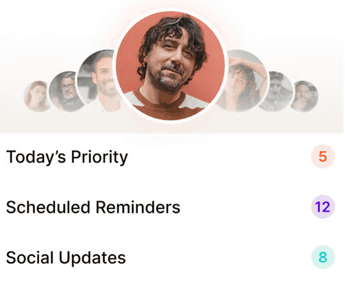
Small upgrade: use an app that does this for you Regards lets you scan a business card and leave a voice note on the contact in one tap. The AI extracts the follow-ups and reminders from what you said. Takes less time than typing a single text. |
Step 2: Sort your contacts the same day
Back at the hotel (or before you sleep), sort your new contacts into three simple buckets. This is the trick that makes everything after it easy.
Bucket A — Priority follow-ups (3–5 people)
These are the conversations where something real happened: a pain point matched, a project is in motion, a mutual introduction is already obvious. Follow up within 24 hours. Personal, specific, and with a clear next step.
Bucket B — Warm keepers (10–20 people)
People you enjoyed meeting but don’t have an immediate project with. Follow up within 48–72 hours. Short, friendly message. Reference something specific. No call request unless it feels natural.
Bucket C — Light-touch (everyone else)
Connect on LinkedIn with a one-line personal note referencing where you met. That’s it. You’re keeping them on the radar without forcing anything.
Most people skip this step and try to write identical follow-ups to 40 humans. That’s why most people’s follow-ups don’t work.
Step 3: Write follow-ups that actually get replies
The best follow-up email or message is short, specific, and pressure-free.
Template — Priority follow-up (Bucket A) Subject: Great meeting at [Event] Hi [Name], Really enjoyed the conversation about [specific topic] on Tuesday — your point about [detail] has been rattling around in my head since. I found this article on [related topic] afterwards and thought you might like it: [link]. I’ve been doing a bunch of work on the [specific challenge / project] area. Would love to exchange notes and see how you’re thinking about it. Hope to see you again soon! [Your name] |
Template — Warm keeper (Bucket B) Subject: Loved meeting you at [Event] Hi [Name], Great meeting you at [Event]. I loved hearing about [specific thing they shared] — it’s exactly the kind of work I find interesting. If [topic they care about] comes up in your world, I’d love to hear how it goes. Added you on LinkedIn so we stay in touch but here’s my number as well (I’m better on text than email). [Your name] |
Template — Light-touch LinkedIn note (Bucket C) Hi [Name] — really enjoyed our quick chat at [Event] about [topic]. Connecting so we can stay on each other’s radar. Save these three templates. Don’t overthink it. Customise the specifics, not the structure. |
Step 4: Organise your contacts so they don’t get lost again
The reason conference contacts usually die isn’t the initial follow-up — it’s what happens after. You reply, they reply, then three months pass and it’s awkward to reach out again.
You need a simple system to track who you met, what you talked about, and when you should reach out next. Spreadsheets work. A personal CRM or networking app works better because it does the remembering for you.
What a good post-event contact system looks like Every new contact logged with: name, company, where you met, one personal detail, one professional detail. A follow-up reminder set for the next touchpoint — usually 4–6 weeks out for Bucket B, 2–3 months for Bucket C. A simple tag for how you met them (“SaaStr 2026,” “BNI dinner”) so you can pull the whole group up quickly. Context you can reference later: what they’re working on, what they’re excited about, what they asked for help with. |
If you’re curious what tools look like in this category, check out Regards. It’s a networking CRM built for conference follow ups. It can scan business cards, extract follow-ups from voice notes, and remind you before relationships go cold.
Step 5: Schedule the second touchpoint before you forget
When you send your first follow-up, immediately schedule the next one. Four weeks out. Six weeks out. Whatever feels right. Put it on a calendar, into a personal CRM, or into your app of choice. Future-you will not remember. Future-you will be grateful.
What to send in the second and third touchpoints
This is where it starts getting hard. It can feel forced or salesy to keep reaching out without context or a reason to. Here are five low-pressure reasons to reach out that always work:
A relevant article, podcast, or report you found that matches something they mentioned
A congratulations on a post, promotion, or launch of theirs
An introduction to someone in your network they’d find useful
A short update on the thing they helped you think through
A simple “thinking of you — how did [the thing] go?”
None of these require you to have news. They require you to have been paying attention.
What not to do
Even with the right tools, poor follow-up habits can quietly undo the value of new connections. Avoid common missteps that feel efficient in the moment but weaken trust and response over time.
Don’t send a generic “great to meet you” email to 40 people
Everyone gets these. Nobody replies to them. You’d be better off not sending anything.
Don’t pitch in the first message
If your first follow-up after meeting someone is a pitch for your service, you’ve confirmed their worst suspicion about networking. Wait at least one or two warm exchanges before anything resembling a sell.
Don’t stall because the moment has “passed”
Two weeks late is fine. A month late is fine. Reference it openly: “Meant to follow up sooner — life got busy.” Then go straight into the specifics. The awkwardness you feel is almost always one-sided.
Don’t try to do it all in one sitting
Processing 40 contacts at once is what kills the habit. Do 5–8 priority follow-ups the day after. Spread the rest across the week. One follow-up per coffee break is enough.
The best apps for following up after a conference
Here are the tools that actually help you stay on top of your connections after the event. They go beyond capture making it easier to remember context, follow up consistently, and build real relationships.
Business card scanners
Good for capture, limited for follow-through. You scan, the data goes into your contacts. But these usually don’t prompt you to follow up, track your interactions, or surface context. Fine as a piece of the puzzle, not the whole puzzle.
Traditional CRMs
Built for sales teams. Heavy, desktop-first, and usually overkill for a solo professional managing a conference contact list. If you’re already running a CRM for your company, you can use it — but most people don’t enjoy it.
Networking apps / personal CRMs
Mobile-first tools built for one person to manage their network. The good ones combine card scanning, voice notes, AI follow-up extraction, cadence reminders, and weekly “who to reach out to” lists. This is the category that actually fits how humans work after a conference.
How Regards fits into your conference follow-up
Regards was built specifically for the job of staying on top of a warm, growing network. At a conference, you scan the business card and leave a voice note (“julia from denver, runs a design agency, mentioned they’re looking for a cofounder”). The AI extracts the follow-ups, sets reminders, and drops them into your next weekly list of 5–8 people to reach out to — with conversation starters based on their LinkedIn activity. Learn more at regardsapp.ai

Why we built Regards
I’m bad at staying in touch. Not because I don’t value people. Its a lot of work, and I didn’t have a system. This started as my fix. A quiet assistant that helped me nurture relationships thoughtfully. When people noticed the difference and asked what I was doing, it slowly evolved into a product. And the love has been incredible. Regards, Khuze

Frequently Asked Questions
How soon should I follow up after a conference?
Priority contacts: within 24 hours. Everyone else: within 48–72 hours. Don’t let it go longer than a week for anyone you actually want to keep in your network.
What do I write in a conference follow-up email?
Reference something specific from your conversation, add one piece of value (an article, a thought, an intro), and — if natural — suggest a small next step. Three to five sentences is plenty. A template with the structure filled in takes about two minutes per contact.
What’s the best app to follow up after a conference?
Look for an app that combines business card scanning, voice notes, follow-up reminders, and a weekly prompt for who to reach out to. Mobile-first is non-negotiable — you’re going to use this in between sessions, not on a desktop. Regards is built for exactly this use case.
How do I organise contacts after a networking event?
Split them into three buckets: priority (3–5), warm keepers (10–20), light-touch (everyone else). Tag each by event. Log one personal and one professional detail. Set a follow-up reminder for each. That’s the whole system.
What do I do when I’ve already missed the 24-hour window?
Follow up anyway — a week late, a month late, whatever. Acknowledge it briefly (“meant to message sooner”), then be specific about what you remembered from the conversation. The moment rarely passes as fully as you think it has.