
Managing a large community is not the same problem as managing a large contact list. The contact list is about volume. Community management is about maintaining meaningful connection — knowing who the connectors are, who is at a pivotal moment, whose engagement is growing or fading, and who you have not spoken to in longer than you should have. At 500 relationships, that requires a system.
Key Takeaways
|
The Community Builder's Relationship Challenge
Community builders occupy a unique position in their networks. They know a lot of people. They are often the person others come to for introductions, advice, or connection. But the asymmetry is real: they cannot give every relationship the same depth of attention that one-to-one professionals can.
The risk at scale is not that relationships go bad — it is that they go invisible. The person who was highly engaged two years ago and has not heard from you in eight months is not angry. They just drifted. And when they needed an introduction, they went to someone who was more present.
A personal CRM for community builders is about intelligent prioritisation: who are the 30–50 relationships worth investing in deeply, who are the 150–200 worth maintaining warmly, and who are the rest that you acknowledge when they surface but do not actively tend?
Segmenting a Large Community for Relationship Management
The segmentation framework that works for community builders borrows from the ambassador/ally/acquaintance model. Your Ambassadors (top 20–30) are your most engaged members, biggest advocates, or most strategically important relationships — they get monthly attention. Your Allies (next 100–150) are active, valued community members — quarterly contact. Acquaintances (the rest) get acknowledged when they are active and reached out to annually or less.
Segment by engagement signal, not just by category. The person who always replies to your messages and makes introductions unprompted is an Ambassador regardless of their industry or title. The prominent member who never engages is not.
Review and rebalance your segments quarterly. People move up and down based on their current level of engagement with the community and with you personally.
Using a Personal CRM at Community Scale
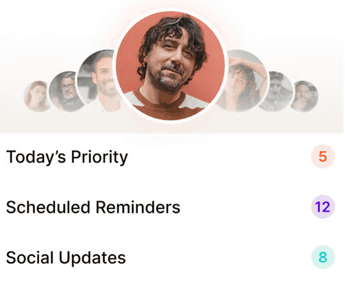
Import your top 100–200 community relationships into your CRM — not everyone, just the ones worth actively managing. Add context for each: how long they have been part of the community, their key contribution or role, personal details that matter, what you have talked about.
Use signal-based outreach to stay present across the broader community. When someone posts something notable, changes roles, or has a business milestone — acknowledge it. These micro-touchpoints maintain warmth across a large network without requiring the depth of a one-on-one conversation.
Use your CRM to track who is making introductions, who is bringing new members in, and whose engagement has changed. This data helps you identify emerging Ambassadors to invest in and Allies who may be drifting — before the drift becomes a departure.
The Return on Community Relationship Investment
The payoff of systematic community relationship management is compounding. A well-maintained Ambassador who feels genuinely cared for by the community builder becomes a recruiter, a connector, and a quality filter for new members. Losing that person to drift is expensive in ways that are hard to measure but easy to feel.
Beyond individual relationships, the community tone reflects how well its central node — the builder — maintains connection. Communities where the central builder is consistently present and personally attentive have stronger network effects, higher member satisfaction, and better referral dynamics throughout.
Regards is built for this kind of proactive, context-rich relationship management at scale — mobile-first, signal-aware, and designed to make consistent outreach a 5-minute daily habit rather than a recurring project.

Why we built Regards
I’m bad at staying in touch. Not because I don’t value people. Its a lot of work, and I didn’t have a system. This started as my fix. A quiet assistant that helped me nurture relationships thoughtfully. When people noticed the difference and asked what I was doing, it slowly evolved into a product. And the love has been incredible. Regards, Khuze

Frequently Asked Questions
How many relationships can one person meaningfully manage with a personal CRM?
With a good CRM and consistent habits, most people can maintain meaningful contact with 150–250 relationships. The tier system — Ambassador, Ally, Acquaintance — extends effective reach further by calibrating depth of attention to relationship value.
Should I include every community member in my personal CRM?
No — only the relationships worth actively managing. The CRM is for tended relationships, not a full member database. Use your community platform for broader member management; use your personal CRM for the relationships where your personal attention matters.
How do I keep track of introductions I make within the community?
Log introductions in your CRM as touchpoints for both parties involved. This creates a record of your connector activity and helps you see which introductions led to meaningful connections — useful both for your own satisfaction and for identifying the highest-value introduction patterns.
What is the biggest relationship management mistake community builders make?
Treating all community members equally at the cost of giving less to the ones who matter most. Segmentation and prioritisation are essential — your Ambassadors need and deserve more of your personal attention than your broader acquaintance network.