
Choosing a networking CRM should not be a weeks-long research project. But it is worth thinking through, because the wrong tool creates more admin than it saves. Here is what to actually look for — and which options hold up in 2026.
Key Takeaways
|
What to Look For Before You Choose Anything
Start with your workflow, not the feature list. If you are at conferences and events regularly, you need a mobile-first tool with easy contact capture. If you manage a large warm network with irregular touchpoints, you need strong reminder and segmentation features. If you have a team, you need shared visibility.
The three questions that cut through the noise: Does it tell me who to reach out to, or do I have to remember myself? Does it surface conversation starters, or do I have to Google before every follow-up? And — honestly — will I open this app every week? The third question disqualifies most enterprise tools immediately.
Pricing is a real factor for small business owners. Most meaningful networking CRM features sit behind a paywall, even if there is a free tier. Budget $15–25 per month for a solo user on a tool that actually works.
Top Networking CRMs Worth Considering in 2026
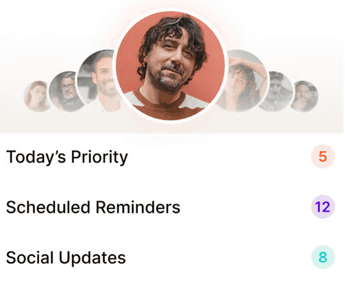
Regards is built specifically for professionals who rely on referrals — it is mobile-first, uses AI to extract follow-up details from business card scans and voice notes, and surfaces proactive outreach suggestions based on your network activity and LinkedIn signals. At $20/month, it is priced for individuals and small firms.
Dex is a personal CRM with strong integration into LinkedIn and email, a clean interface, and decent reminder functionality. It suits solo users who want to organise contacts with some automation. Less proactive than Regards — it surfaces things when you look, rather than coming to you.
Clay is powerful for people who want to build deeply enriched contact databases with automated research. It is more of a data platform than a relationship assistant — best for agencies or BD teams that want to segment and enrich at scale, less ideal for the busy individual who needs quick daily habits.
HubSpot CRM Free exists, but it is a sales CRM with networking bolt-ons — not a networking CRM. It works for pipeline management. It does not work well for 'stay in touch with 200 warm contacts consistently.'
How to Choose Based on Your Situation
If you are a solo service provider or small business owner who relies on referrals and attends events: Regards. It is built for exactly this use case — lightweight, mobile, proactive, and relationship-first.
If you are a BD professional or agency with a larger team and want enriched contact data with automation: Clay. More setup required, higher ceiling.
If you are a freelancer who wants basic contact organisation with some reminders and does not need proactive AI features: Dex is a reasonable starting point.
The honest advice: try one. Most tools have a free trial or free tier. Two weeks of daily use will tell you more than any feature comparison chart.
What Most People Get Wrong When Choosing
Choosing the most powerful tool rather than the most usable one. A CRM you do not open is not a CRM — it is an expensive guilt trip. Simplicity and habit-friendliness beat features every time.
Importing every contact you have ever had. Start with 50–100 of your most valuable relationships. A networking CRM you actually use for 100 contacts outperforms a perfectly populated database that you never check.
Expecting the tool to do the relationship work. A networking CRM surfaces who and when. You still have to be genuinely curious, helpful, and human. The tool makes the system; you make the connection.


Why we built Regards
I’m bad at staying in touch. Not because I don’t value people. Its a lot of work, and I didn’t have a system. This started as my fix. A quiet assistant that helped me nurture relationships thoughtfully. When people noticed the difference and asked what I was doing, it slowly evolved into a product. And the love has been incredible. Regards, Khuze

Frequently Asked Questions
What is the best free networking CRM?
Most genuinely useful networking CRM features require a paid plan. Regards offers a free trial. For basic contact organisation, Dex has a free tier, though proactive features are limited.
Do I need a networking CRM if I already have Salesforce?
Salesforce is a sales CRM — it tracks deals, not relationships. If you depend on warm referrals, you likely need a separate tool to manage the relationship layer that feeds your pipeline.
Is there a networking CRM that works with LinkedIn?
Yes. Regards surfaces conversation starters based on LinkedIn activity. Dex also integrates with LinkedIn. Clay can pull LinkedIn data at scale for enrichment.
How many contacts should I put in my networking CRM?
Start with your top 50–100 most valuable relationships. A focused, well-maintained list you actually act on beats a 5,000-contact database you ignore.
How is a networking CRM different from a contact manager like Google Contacts?
Google Contacts stores information. A networking CRM is proactive — it reminds you who to contact, surfaces what to say, and helps you build consistent habits. It is a system, not just a database.