
Relationship building is becoming a core business skill in the modern era. As businesses evolve beyond purely transactional models, those that invest in relationships tend to sustain and grow over time.
For founders, entrepreneurs, and small business owners, this shift creates a practical challenge. Balancing growth, operations, and relationship management is not straightforward. A personal CRM helps bring structure to this challenge. This blog explains what a personal CRM is, how it eases a founder’s day, and a few best-rated options available in the market.
Key Takeaways:
|
What Is a Personal CRM
A personal CRM is a simple system used to organize and maintain relationships. It helps keep track of customers and the personal nuances that make each relationship more human, in one centralized place.
Beyond basic details, a personal CRM captures:
Relationship origin
Key conversation records
Relevant interests
Follow-ups with context
Reconnection reminders
Many founders attempt to manage this mentally. A personal CRM reduces that effort by making it easier to stay in touch and nurture relationships over time.
Check out this quick article to understand the best CRM features for small businesses in 2026.
General CRM vs Personal CRM
A general CRM is built for companies to manage business-to-customer activity at scale. It supports sales, marketing, and customer support teams by organizing leads, pipelines, deal stages, and customer data within structured, revenue-oriented workflows.
In contrast, a personal CRM is built for individuals to manage their network. It is designed around one-to-one relationships, bringing scattered conversations into a single system that is easy to review.
Why Founders and Entrepreneurs Need a Personal CRM
A day in a founder’s life involves multiple conversations across their network, spread across platforms and time. Keeping track of all this without structure becomes difficult. This is where a personal CRM becomes useful. It helps by:
Centralizing contacts and relationship data that otherwise sit across disparate channels like emails, messages, and spreadsheets
Ensuring important follow-ups and check-ins are not missed
Retaining context from past conversations, leading to more relevant and personal interactions
Helping founders prioritize opportunities without relying purely on memory
#1 Regards - Best Personal CRM
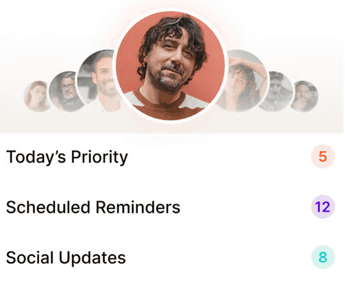
Regards is a mobile-first personal CRM that keeps things light and practical for founders. It avoids the usual CRM fatigue that comes from setup and constant updates.
It works well because:
There’s nothing to set up or maintain
It nudges you on who to reach out to, instead of asking you to plan it
It remembers important details for you
Check-ins stay human and natural, not salesy
Standout feature: It fits into a five-minute daily routine without feeling like a task.
#2 Monica
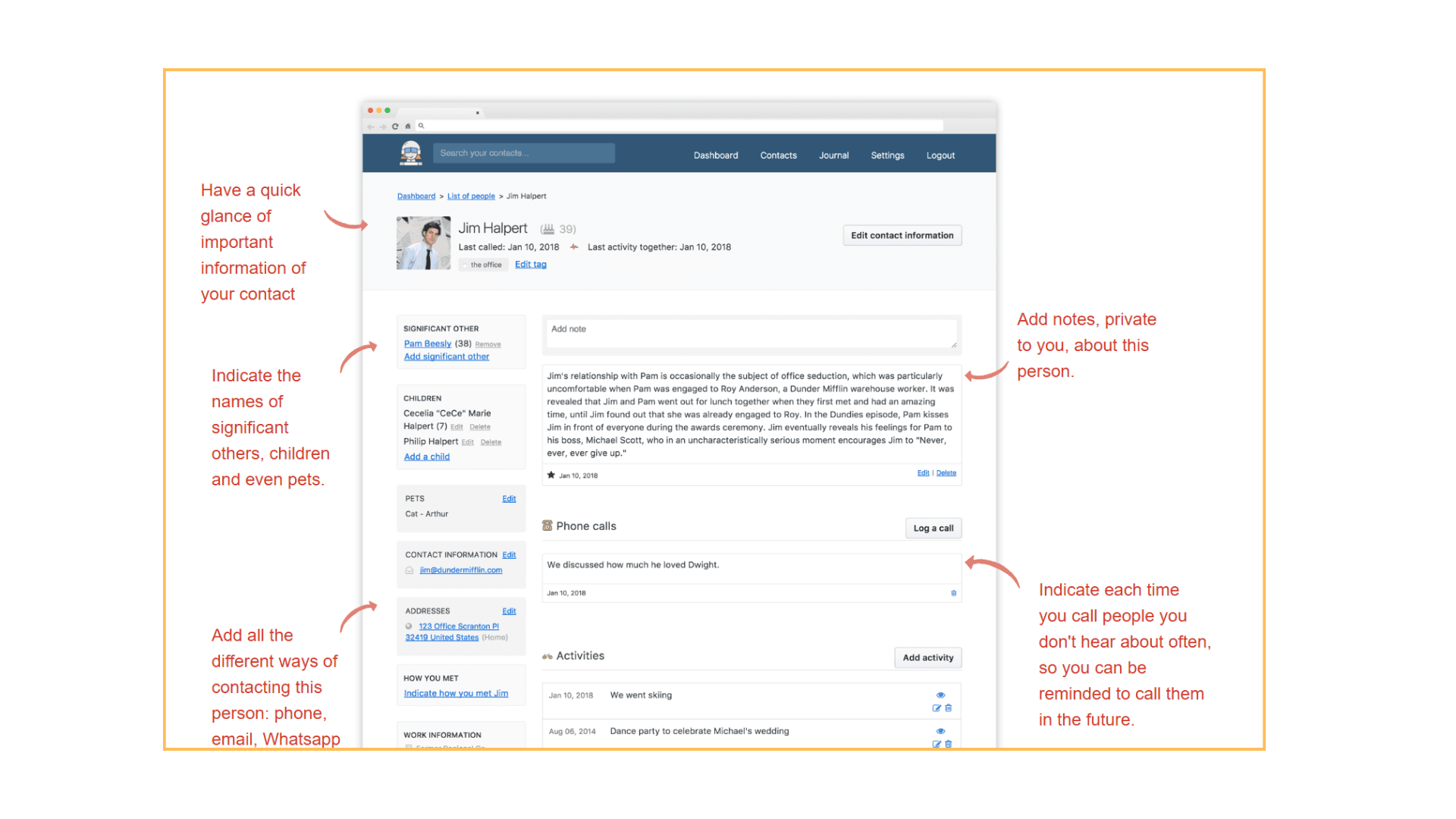
Monica is an open-source personal CRM for founders to keep track of people, conversations, and reminders, without forcing any sales structure on top of them.
Entrepreneurs and founders can use it to maintain structured records for each contact. This includes notes from conversations, stored messages and photos, and reminders tied to specific contexts. Over time, it becomes easier to catch up with the network without having to start from scratch.
Standout feature: Life-event tracking with recurring reminders.
#3 Dex
Dex acts as a personal relationship manager for entrepreneurs. It consolidates contacts from LinkedIn, email, and other everyday tools into a single place, keeping past conversations and touchpoints visible and synced at the contact level.
Its strengths include: contact grouping, filtering and search, and browser extensions that support quick contact capture and updates.
It works best for: solopreneurs, founders, investors, and creative professionals.
Standout feature: Direct LinkedIn sync that auto-updates role changes and contact information.
#4 Clay
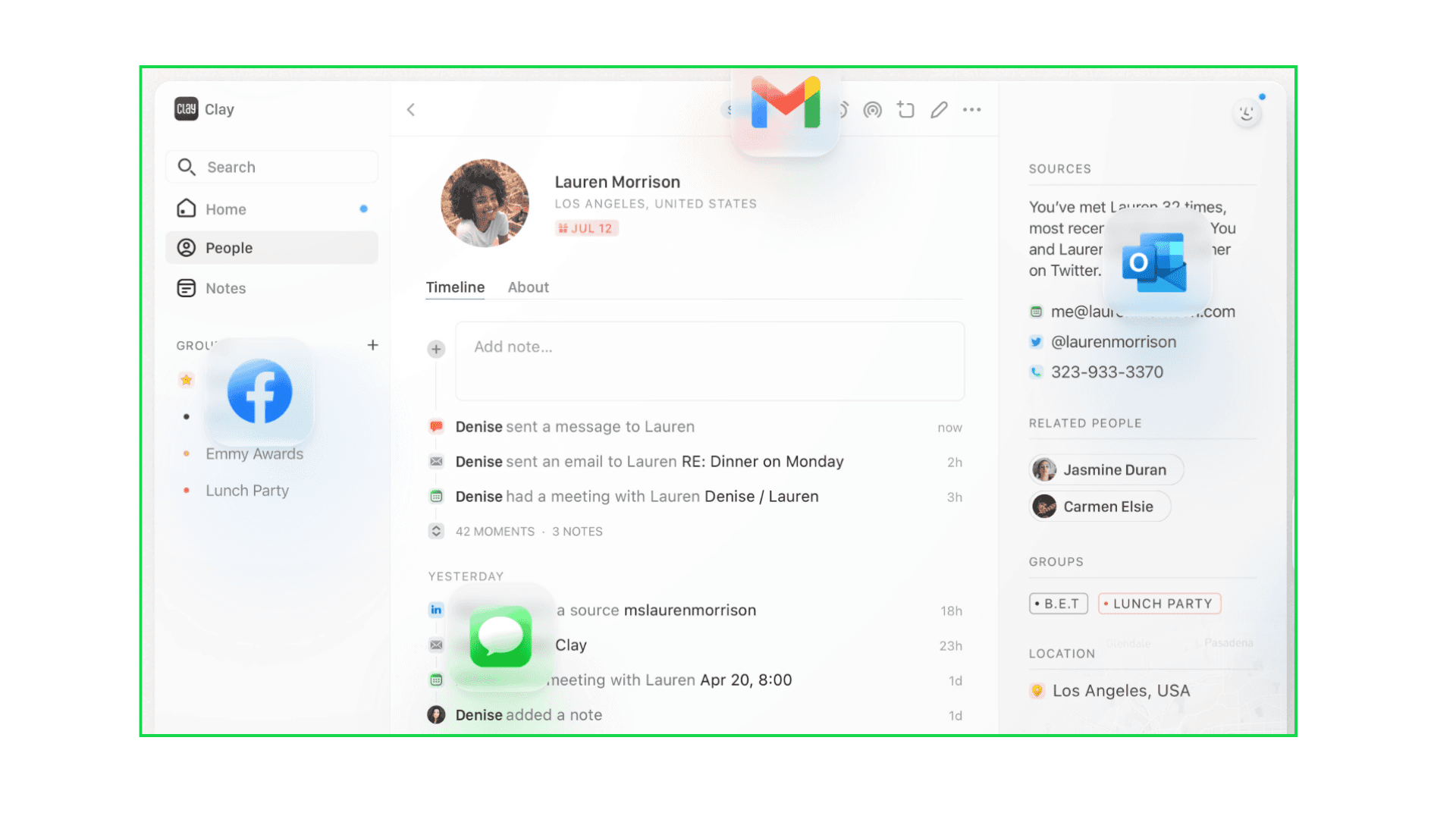
Clay is a personal CRM that keeps a network organized, searchable, and up to date, without requiring constant manual effort. Its notable capabilities include:
Automatic contact import from phone, calendar, and WhatsApp
Enrichment of work-related details through LinkedIn and Twitter
Smart reminders that follow a regular cadence
Standout feature: Conversational search that lets you ask direct questions across contacts and interactions.
#5 Folk
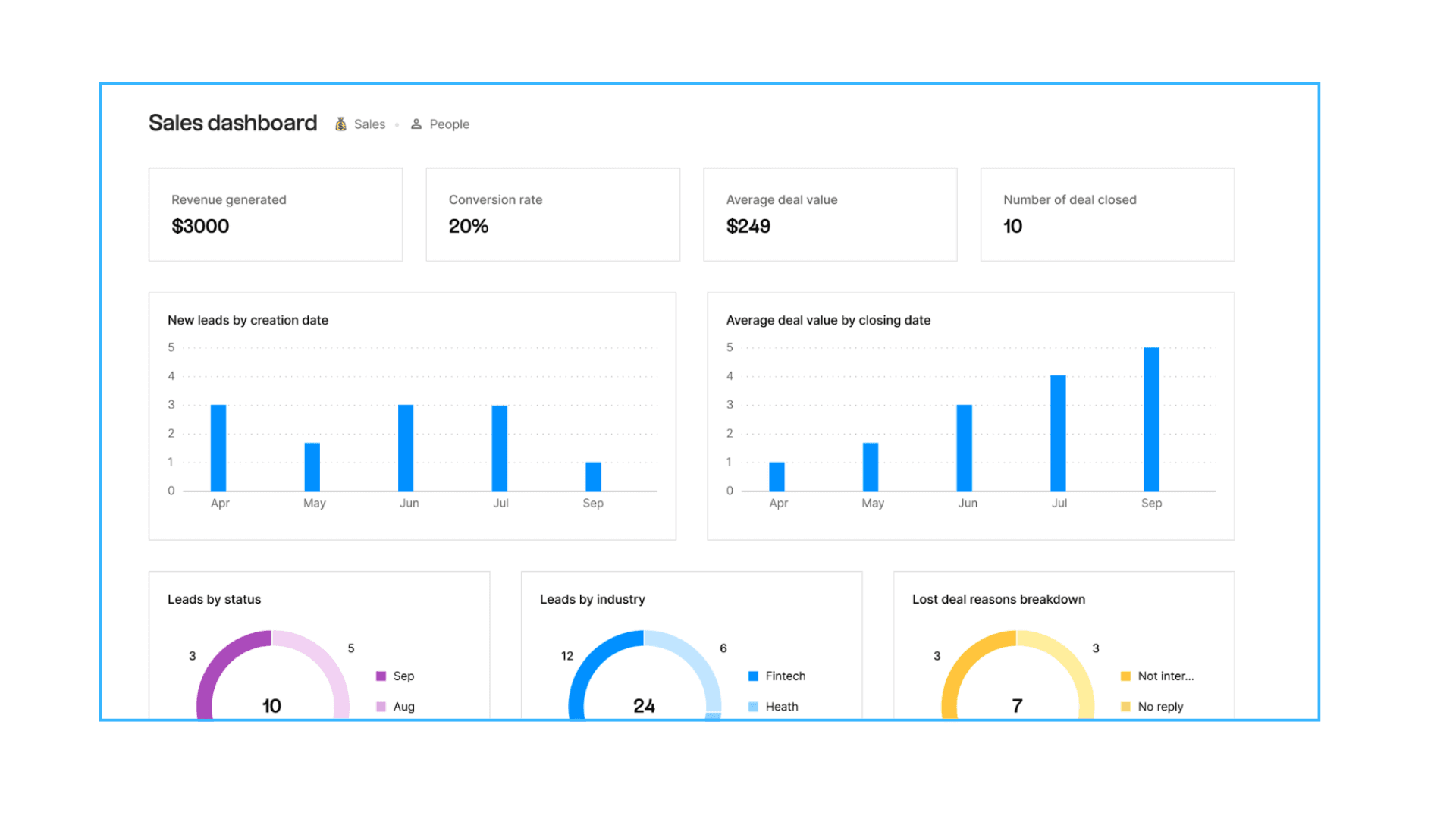
Folk is built for founders who want structure around customer relationships but don’t want traditional CRM complexity. It captures contacts quickly and fills in relevant details along the way. Here’s what makes it a good fit:
Automation for personalized outreach through emails and sequences
Smart fields that surface contact information in one click
Automatic enrichment of contact and company details
Standout feature: Excellent WhatsApp Web & ChatGPT integration
Conclusion
Having a personal CRM is like having a full-time personal relationship manager by your side, without the human errors and complexities of missed follow-ups, memory lapses, and communication slips. So, do yourself a favour by picking a personal CRM that fits the core of how you work.

Why we built Regards
I’m bad at staying in touch. Not because I don’t value people. Its a lot of work, and I didn’t have a system. This started as my fix. A quiet assistant that helped me nurture relationships thoughtfully. When people noticed the difference and asked what I was doing, it slowly evolved into a product. And the love has been incredible. Regards, Khuze

Frequently Asked Questions
How to choose the best personal CRM software for my business?
The best choice depends on your personal style, business goals, and how you prefer to be assisted with relationship management. A good starting point is to clearly define what the system must handle, decide which actions to automate versus handle manually, verify that the tool fits your existing workflow without requiring major changes, and start with a free plan to ensure it works for you consistently.
Is customization possible in a personal CRM?
Yes. Customization in a personal CRM usually comes in the form of industry-specific features, flexible contact fields, and editable labels that help tailor how workflows are managed. Deep, system-level custom reconfiguration is not common in personal CRMs, so the focus stays on managing relationships rather than managing the tool itself.
Does a personal CRM allow you to manage sales pipelines?
Some personal CRMs offer pipeline views, but they are secondary. If tracking deals and conversions is a priority, a general sales CRM is better suited. A personal CRM works best when business growth involves staying in touch and building relationships over time.
What is the best CRM built for people to keep in touch?
Since people have different ways of staying in touch, the best personal CRM is simply the one that smartly keeps conversations visible, provides timely reminders, and retains details you might otherwise forget, all without feeling like an extra system to manage.